Laser technology might have transformed the landscape of dermatology in many ways, but Consultant Dermatologist Dr Louise O’Halloran says it hasn’t taken over the day-to-day practice of what she does for patients.
“A lot of what we’re doing as dermatologists is managing skin cancer requiring surgical excision or, alternatively, treating someone with psoriasis or eczema who may need to consider topical therapies, oral immunosuppressives, biologics, or narrowband UVB phototherapy.
“Lasers are simply another tool in our toolbox that we use for particular conditions, to assist in managing the conditions we treat in the field of Dermatology. They can be very helpful, with good evidence from published research on their benefits.
“Lasers are far more sophisticated than they were, say 15 years ago, because the technology wasn’t as good then. Lasers have been used in Dermatology for some time now. We have used a vascular laser in our Dermatology department at Perth Children’s Hospital for many years, for port wine stains and ulcerated infantile haemangiomas.”
Dr O’Halloran, an AMA (WA) member, says one of the improvements in laser treatments is that the downtime for patients has reduced significantly.
“This makes it more accessible to patients, because previously with some CO2 laser treatments patients might have a downtime of one to two weeks where their skin was incredibly swollen, which makes that treatment much more undesirable,” she says.
“ Laser devices are not taking over all the things we do as dermatologists. It’s simply another tool to assist in managing the various conditions we treat in the field of Dermatology.

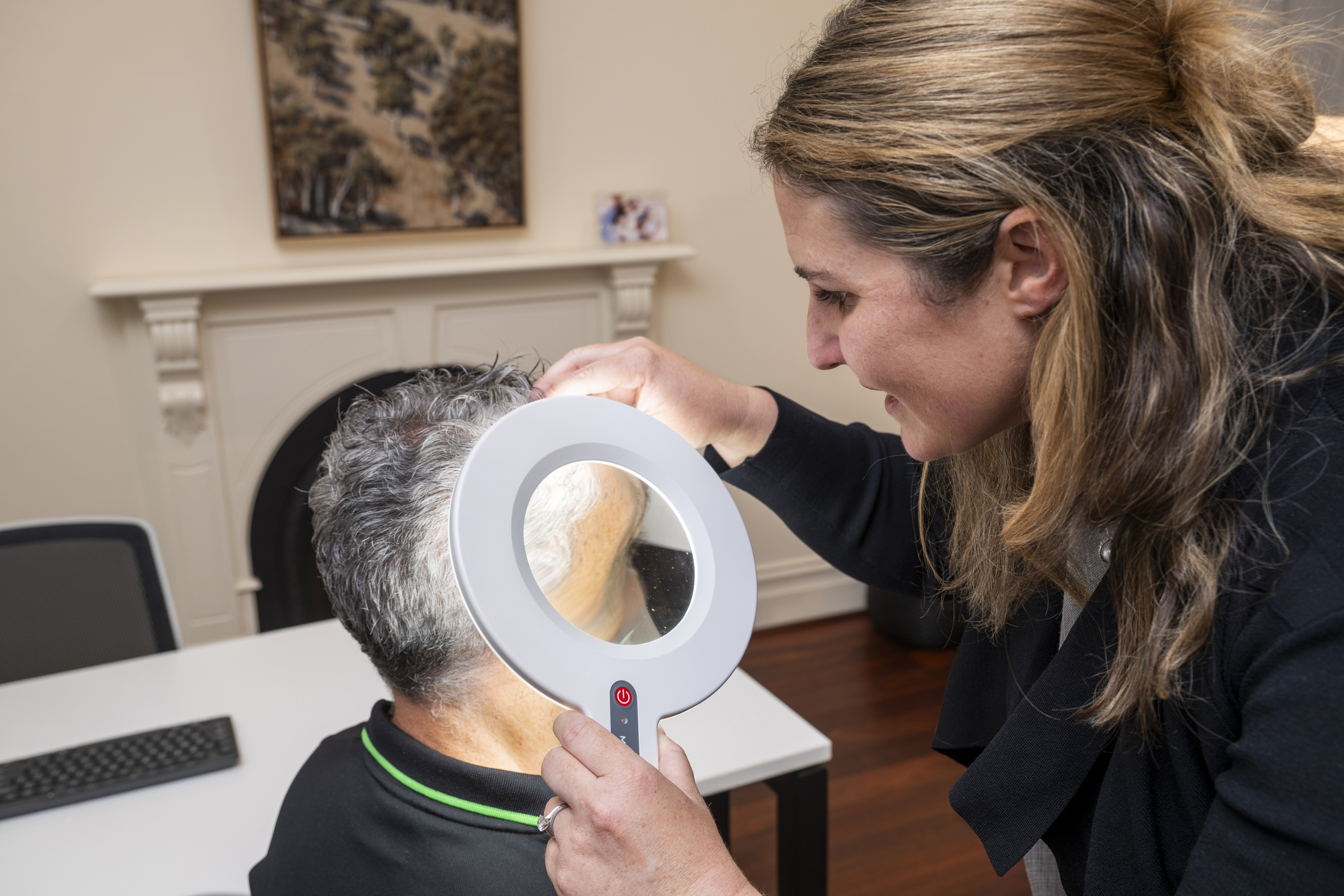
Consultant Dermatologist Dr Louise O’Halloran examines a patient using a MaggyScan Portable LED Magnifier Lamp.
“The improved technology, with lower downtime through fractionated CO2, means patients can go back to their usual activities a lot sooner.”
Dr O’Halloran says laser treatment can be used as one part of a treatment plan for a lot of patients.
“It’s not replacing traditional treatment options, but it certainly can be used as an adjunctive therapeutic treatment for particular skin conditions,” she says, “or as an alternative, for example, for patients who don’t necessarily want surgery but just want to explore other options that are non-surgical or non-cream-based treatments for pre-cancerous cells.
“You’re going to get a longer-term benefit by considering using lasers for something like rosacea. Not all types of rosacea, and it’s important to stipulate you’re not going to be able to clear all types of rosacea just with a vascular laser. You will do it in conjunction with creams and oral agents. The laser is used as an adjunctive part of a treatment plan.”
Dr O’Halloran says there are broadly three types of lasers in dermatological use: vascular lasers that treat redness; pigment lasers that treat pigmentary troubles and pigmentation; and CO2 lasers, a “resurfacing” type that can treat a wide range of conditions. With more modern lasers, however, settings can be changed on these devices, where one device can treat a more diverse range of conditions.
“An example of a medical condition where you can use a vascular laser would be port wine stains in babies,” she explains. “Another would be infantile hemangiomas, which can become ulcerated during their rapid growth phase. Vascular lasers can assist significantly in the treatment of ulceration and also improve erythema.
“Moving on to adults, you can use it for rosacea and it’s quite effective especially in erythrotelangiectatic rosacea. You can use it for post-inflammatory erythema after acne has resolved; and following surgical scarring, which would be deemed more cosmetic. So, there are medical conditions and more cosmetic uses.
“If we look at a CO2 laser, you can use it to manage superficial skin cancers and solar keratoses, or a condition called actinic cheilitis where you have precancerous changes to the lip; or for people who have quite severe rhinophymatous rosacea where they get a thickened and swollen nose, due to sebaceous gland fibrosis.
“CO2 lasers also assist in the management of many skin issues, including keloidal scarring and other scars such as burns scars following surgeries. The Burns Unit at Fiona Stanley Hospital has used one for many years to assist in improving the functional and aesthetic appearance of patients’ burns scars.”
“ CO2 lasers assist in the management of many skin issues, including keloidal scarring and other scars such as burns scars following surgeries. The Burns Unit at Fiona Stanley Hospital has used one for many years to assist in improving the functional and aesthetic appearance of patients’ burns scars.
Dr O’Halloran says another advance in technology over the past decade or more has been to enable the doctor to program the settings on the laser to suit the patient’s skin and what you’re trying to treat.
“You can make it a stronger setting or slightly less strong depending on the patient’s skin colour and the amount of sun damage they have,” Dr O’Halloran says. “You can manually change the settings to make it more bespoke depending on the individual patient you’re treating; whereas historically, it was harder to change the settings because the machine just wasn’t as advanced in its technology.”
Another advancement allows for the treatment of darker skin types.
“You classify skin pigmentation through the Fitzpatrick skin type,” Dr O’Halloran explains, “so patients with a higher Fitzpatrick skin type will have darker skin. You can now use these lasers, with caution and under the right supervision, on darker Fitzpatrick skin types.
“You still do need to be very careful, ensuring you do a full skin check of the treatment area and the patient, and ensure they’ve got no underlying skin cancers before commencing treatment. It’s very important that you assess this before treating with any laser.”
You're just getting to the good part! Log in to your AMA (WA) member account to continue reading, or join today for full access to exclusive content, member benefits, and more.
Month End Offer is live!
Get up to 40% off on AMAMedius
Sign in using your membership email and date of birth.