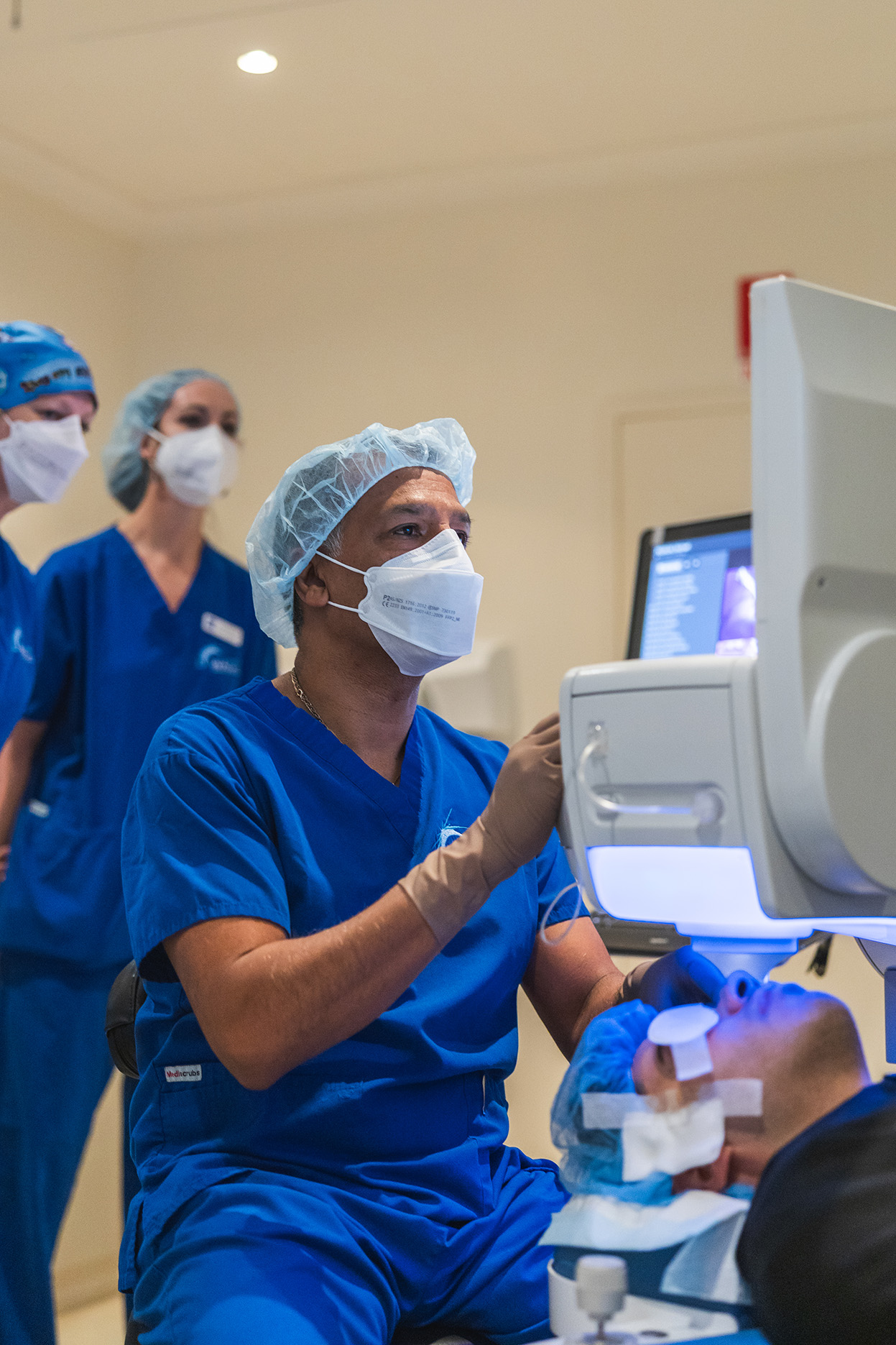
Rob performing laser eye surgery.
When did you first know you wanted to be a doctor?
It’s a funny story, but I was really adamant I wanted to be a vet, as my childhood best friend and I made a pact to do this. But my dad made me put down Medicine as my first choice, despite my protests. While waiting for my results, I saw a video on a cow being delivered and thought, “Oh no, I don’t think I can do that!” Then I realised I didn’t like birds that much either, so I was glad when I got the marks to do Medicine, as I wouldn’t have been a good vet.
Why did you join the AMA?
I became familiar with the AMA as a medical student and admired the way they advocated for our profession, both at the state and federal level. The voice of our AMA leaders over the years was one that was respected. They were influential in determining health policy and championing the rights of our members and the public at large by challenging the agendas of politicians when it conflicted with AMA policies.
Why did you join the AMA (WA) Council?
Over the last 20 years I’ve previously served as a council member of our Federal Ophthalmology College (RANZCO) as well as Secretary and Treasurer of the WA RANZCO. I’ve also acted as an Examiner for the Part 1 Ophthalmology exams and sat on the State Advisory Committee for MDA National.
I really enjoyed the interaction with colleagues and trainees, as well as contributing to discussions that shaped policy, education, and fiscal management. When the opportunity to join the AMA as a craft representative arose, I was very enthusiastic to adopt the role. I was interested in understanding the inner workings of the AMA, specifically learning more about industrial relations and doctors-in-training issues, and how the AMA formulates opinions at short notice to the inevitable health crises and issues that arise.
Why did you choose your specialty?
I was actually tossing up between Neurosurgery and Ophthalmology, as I was fascinated by the technology and microsurgical skills each specialty demonstrated. I saw a corneal transplant being done and the suturing was so exquisite, I thought I’d love to be able to do that.
Another lesser reason was that the Neuro registrars looked exhausted each morning from the gruelling workload, but during my eye term the registrars used to bounce in – so I thought there had to be something in that.
What would you tell a young doctor looking to work in your specialty?
I’d have no hesitation encouraging them to apply for this, it is such a rewarding profession. My only advice is that because it’s so competitive, you have to commit 110% and be prepared to make significant sacrifices. I like that it is both academic and surgical in nature. The patients are so grateful, as the results of surgery are realised quickly. The technological advances in Ophthalmology are constantly evolving and a regular source of excitement.
What advances in medicine are having the greatest impact on your practice?
Advances in imaging techniques in instruments using OCT and Scanning Laser Ophthalmoscopy are helping us as clinicians to diagnose and treat eye conditions earlier. Essentially, we get ‘MRI’-quality images of eye structures right down to the cellular level. There’s no doubt AI will be (and has been) incorporated into these diagnostic devices such that a clinical diagnosis can be made without physician input or analysis.
Perhaps the biggest advance that has impacted my practice is in the sphere of Laser Eye Surgery correction of reading problems. Presbyopia will affect all of us after 40 years of age, and new software algorithms now allow us to successfully manage it with Presbyond Lasik surgery. In addition, new Multifocal Intraocular lenses are more effective than ever and can be employed in standard cataract surgery to remove dependency on glasses.
Are there any heroes or mentors who’ve guided your path so far?
The earliest influence was obviously my mum (a teacher) and dad (pilot/air traffic controller) who sacrificed a lot to ensure a good education. They instilled strong beliefs, confidence and work ethic. My brothers helped develop my competitive streak, and my wife has been my rock over the years with her logical advice and unwavering encouragement and support ever since our days in med school. She continues to work alongside me in the practice, as well as raise my three beautiful daughters into wonderful young women whom I’m so proud of.
In terms of mentors, there were many; but special mention has to go to Ophthalmologists Chris Kennedy (my registrar when I was a resident), Ian McAllister (who got me on the training program), Fred Nagle (who gave me my Consultant job at Fremantle Hospital) and David Rootman (Corneal and Refractive Fellowship Supervisor in Toronto).
While it seems unusual to mention a competitor as a mentor, I must acknowledge Phil McGeorge, who gave me my first Laser Refractive job when I returned from Fellowship training. I’ll also cherish the time I spent working with the Ike/Jeremy Raiter/Graham Chester group. The amazing practice staff I’ve worked with over the years have been integral to my journey.
What’s the first issue you’d tackle if you were WA Minister for Health?
It would have to be addressing the disparity between the public and private health systems waitlists. On average, a public patient with category 3 cataract waits one year to be seen. If you are category 2, which means you are unfit to drive in most cases, you wait 90 days!
This is driven in part by the poor surgical efficiency, which can be as little as four cases on a half-day list (in private practice, the range is 6-24). The role of private health insurers in pushing the size of the public waitlist should not be underestimated. With the cost-of-living crisis worsening and health insurers driving up prices above CPI, it’s no wonder there’s a drop in privately insured patients. The health funds also acted furtively by changing patient coverage so that only patients with Silver Plus and above were covered for cataract surgery, whereas previously lower levels covered it.
I’m sure these actions have impacted other specialties too. The WA Government has options: regulate the health funds price gouging and/or prevent the commonest operations from being subjected to tier discrimination (which obviously needs collaboration with Federal Health). The other option is directing more funds to regular, not temporary, waitlist reduction programs. The current way Bentley Health Campus operates is that public lists become available with one month’s notice to VMOs who have waitlisted public patients via their private rooms or RPH – then a bunfight ensues among surgeons to get lists, and a scramble to reschedule clinics to operate.
This system replaced a well-oiled machine with regular lists allocated to VMOs. The sole purpose of this change was to reduce patient throughput and therefore save government dollars. What’s the point of building a speedway and paying for a WA rugby team when the ageing population are too blind to watch?
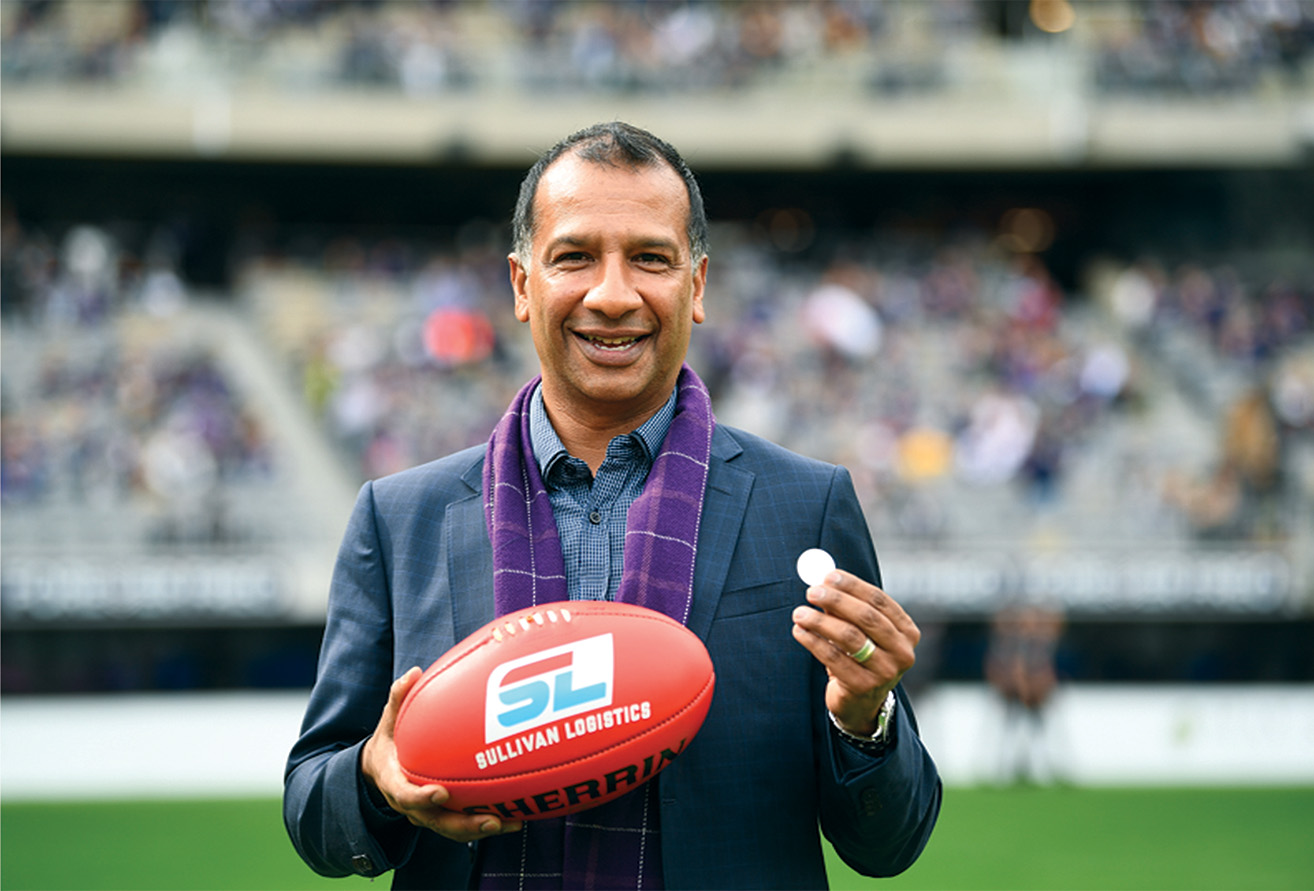
Rob tossing the coin at a match for his beloved Dockers.
If you weren’t a doctor, what would you be?
Like everyone else, if I had the talent (I don’t) my dream job would be an international rock star.
How do you spend and prioritise your time away from medicine?
I try to exercise regularly at the gym and go to bike bar (high-intensity cycling). I’ve recently taken up walking – hopefully one day being able to walk the Camino! Our family are proud Fremantle Dockers members and sponsors, so most weekends are spent watching or attending games, which is a great release. I love to spend time with my family, so we usually go on yearly overseas trips together, as well as smaller ones during the year.
What’s the one lesson you always remember?
It doesn’t matter how hard something is. If it’s humanly possible, you can do it.
What’s something your parents impressed upon you?
Work hard, have faith, and run your own race.
What’s your ideal holiday destination?
Florence or Whistler – I can’t decide.