Claim EA: Professional Reading CPD hours with AMA CPD Home. Learn more in our helpful article and log your hours.

An internationally lauded clinical trial by researchers at The University of Western Australia has shown there are quick and effective ways in daily life to reduce the levels of harmful plastic-associated chemicals in our bodies. But some unexpected results of the study were not so positive.

An editorial in Nature Medicine earlier this year heralded the results of a Western Australian-run clinical trial that had been able to reduce the levels of two plastic-associated chemicals (PACs) in the bodies of study participants, by limiting plastics use in the food chain and in people’s diet and everyday life.

The randomised controlled trial, led by internally renowned UWA clinical immunologist Professor Michaela Lucas, had even managed to lower the percentage of phthalates and bisphenols, known endocrine disruptors, in just seven days; and in the best-case scenario the reduction was more than 50%.

PERTH Trial team: Dr Andrew Lucas, Prof Michaela Lucas and Dr Amelia Harray.

This was a good news story, but the authors of the Nature Medicine editorial also picked up on some results in the trial that were unexpected.

“Additionally, they found that levels of di(2-ethylhexyl) phthalate [DEHP] increased in all low-plastic diet interventions… This leads to the question of whether these chemicals are in the food at the time it is harvested,” they wrote.

It’s a question that’s clearly on the mind of Professor Lucas, an AMA (WA) member, because she makes a point of talking about the DEHP results and something else in the RCT paper, published in Nature Medicine, that she thinks have been overlooked in mainstream coverage.

“The big message is that if you do what we’re doing in the trial, you can reduce the plastic-associated chemicals in your body in a period of a week. They really flush out consistently,” she says.

“But the other thing we found is that we could only reduce bisphenols and low-molecular phthalates. There is, however, this very dangerous chemical called DEHP, which is a high-molecular phthalate, and we weren’t able to reduce it.”

There were three groups in the Plastic Exposure Reduction Transforms Health (PERTH) Trial cohort who had a mandated healthier diet, with less processed food and more fruit and vegetables, and yet their DEHP levels went up rather than down.

“It wasn’t super significant, but there was a trend,” Prof Lucas says. “This raises the problem that if your exposure to this chemical is not coming from the packaging of the food and the touch points of the plastic, and it doesn’t come from your personal care products, where is it coming from?  This raises, of course, the possibility, raised in the editorial and what’s emerging in the literature, that some of these chemicals are literally inside the food.”


We identified that food was a major source, particularly if you consume a lot of ultra-processed, highly processed food. And another example was the lining of tins that came up as a contributor to the level of bisphenols in your body.

Prof Lucas says the other study finding that is not appreciated enough, and her research team has continued to investigate, is that the trial showed the extent to which a person excretes these PACs in their urine is directly proportional to their fat mass index.

“We had done body composition in all our participants,” she explains. “So, if you are obese versus lean and you get the same exposure of plastic-associated chemicals in your diet, and we could model that, then the lean person would excrete a lot more of those chemicals within the 24-hour period than a person with obesity, meaning that they retain some of those chemicals in their fat tissue.

“Females naturally have higher fat mass indexes, particularly subcutaneous fats. So, females who are obese and eating the same amount of chemicals will significantly, highly significantly, excrete a lot less, particularly of DEHP.”

The longitudinal PERTH Trial, initially funded by a $5.5 million grant from the Minderoo Foundation, started with an observational cohort of more than 200 participants, clinically confirmed to be in good health, who were brought together between November 2022 and September 2023.

The research team, which includes UWA research fellows Dr Amelia Harray and Dr Andrew Lucas (Prof Lucas’ husband), developed a world-first 24-hour survey tool – the Plastic-Associated Chemical exposure Questionnaire (PACeQ) – that collected data from the cohort to investigate associations between PACs and diet and lifestyle behaviours, body composition and blood biomarkers. Test results showed that 100% of these initial participants were excreting at least six PAC metabolites on any given day.

“That behaviour analysis, in conjunction with measuring the plastic exposure of people in their urine, particularly the plastic-associated chemicals, allowed us to understand where the high exposures from plastic come from in our everyday lifestyle,” Prof Lucas says.

RESEARCH FACTS

  • Test results from the initial PERTH Trial cohort showed that all participants were excreting at least six plastic-related metabolites on any given day.

  • In the randomised controlled clinical trial, the maximum intervention resulted in phthalates decreasing by more than 44% and bisphenols by more than 50%.

  • The trial showed that a lean person will excrete a lot more of these chemicals within a 24-hour period than a person who is obese.

“We identified that food was a major source, particularly if you consume a lot of ultra-processed, highly processed food. Another example was the lining of tins that came up as a contributor to the level of bisphenols in your body.

“We then took all that information and developed an intervention where we worked with farmers and producers to produce food that never touched plastic, or we minimised plastic touch points where we could, though still operating within food-safety regulations.

“That was stage 2, the intervention, and it showed that within a week you can reduce the levels of these plastic-associated chemicals by making changes.”

The stage 2 intervention, really a pilot study, ran for a week and involved 60 people from the original cohort. The in-depth, low-plastic, isocaloric dietary intervention worked directly with primary food producers, a meal delivery service, and the highly engaged participants to remove all modifiable plastic touch points in food from paddock to plate.

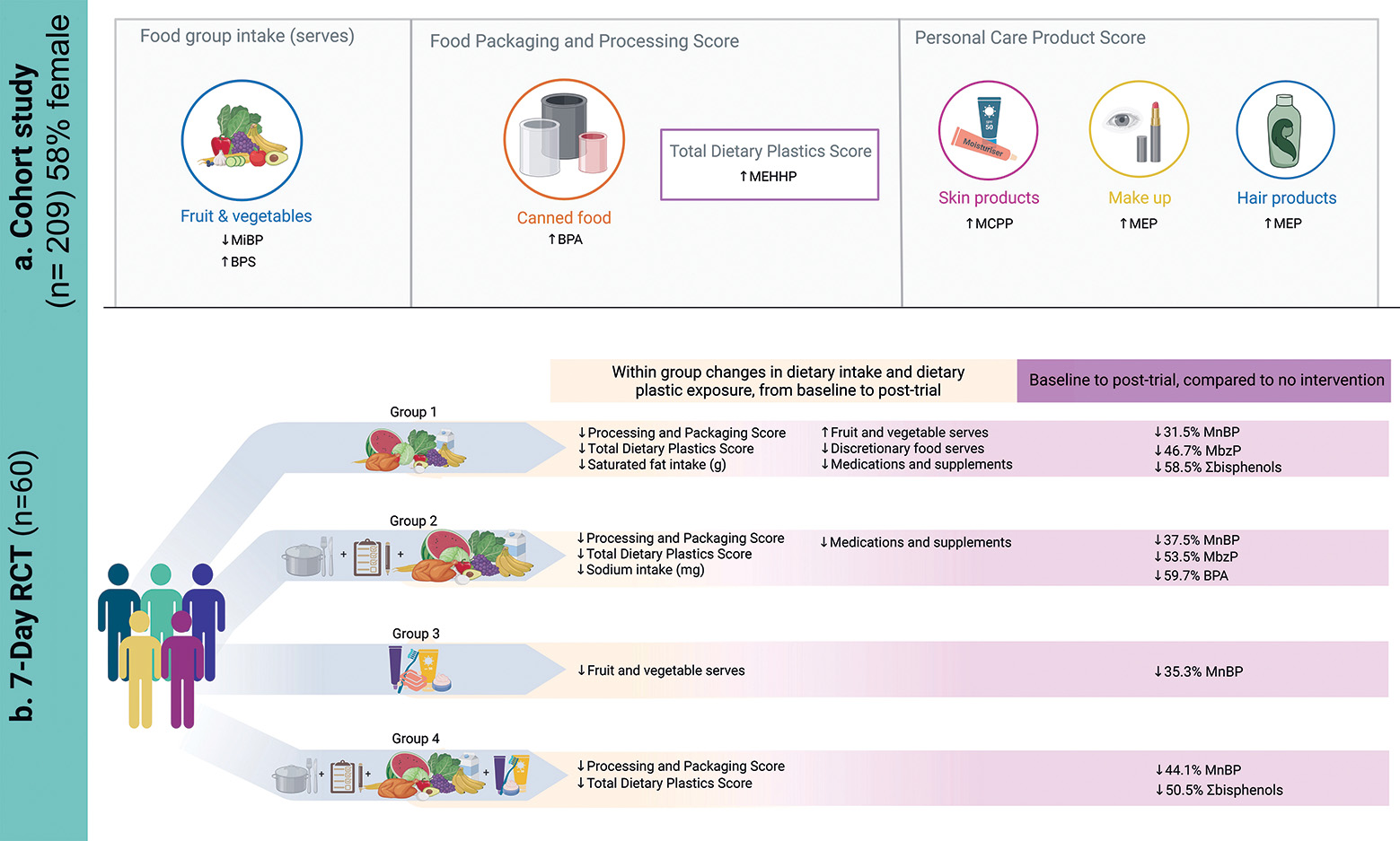
The RCT cohort was split into five groups of 12:

    • Group 1 – diet change to low-PAC food;
    • Group 2 – diet change, plus low-PAC food utensils and food preparation (metal pots, metal kettle, metal toaster, wooden chopping boards, no nonstick pans);
    • Group 3 – no dietary change, but use personal care products certified to be low in PACs;
    • Group 4 – low-plastic food, no plastic kitchen utensils, and a change of personal care products; and
    • Group 5 – the control group with no intervention.

In Group 4, the maximum intervention, the phthalates decreased by more than 44% and bisphenols by more than 50% compared to the control group.

“The biggest effect was due to the foods, and there was a slightly increased reduction of some of the phthalates if you were to change the kitchen utensils,” Prof Lucas explains.

“When you change just the personal care products, they didn’t really reduce the bisphenols, but just some of the low-molecular phthalates.”

A graphic from the trial showing associations between dietary intake, behavioural plastic exposure and urinary PAC levels.
The intervention showed that within a week you can reduce the levels of these plastic-associated chemicals by making changes.

Even before the initial PERTH Trial results were published in Nature Medicine in April, the research team had completed stage 3 of the ongoing trial, supported by additional funding, that investigated the effects of PACs on “bigger bodies” – people with BMIs over 30.

“This is really on people having risk factors for cardiometabolic disease and understanding how a reduction in plastics leads to improvement of cardiometabolic disease,” Prof Lucas says.

“That trial has really given us a lot of food for thought, particularly thinking about how, if plastics can be almost an independent risk factor of driving cardiometabolic disease, you can integrate that or translate it into a more clinical application for people suffering from cardiometabolic disease. That’s a big one,” Prof Lucas says.

This stage 3 randomised control trial, involving 60 participants – 30 in the control group and 30 in the intervention group – had an intervention for four weeks. The team measured participants’ biomarkers before and after.

“That’s already completed and that’s what we’re currently analysing. So, obviously, watch this space to see what’s come out of this trial,” Prof Lucas says.

Stage 4 of the ongoing trial is understanding how a low-plastic lifestyle improves reproductive health.

“This is initially looking at how it improves reproductive health in regard to males, particularly the quality of their sperm and seminal plasma; and in regard to females, looking really at how it influences the hormones of their cycle,” Prof Lucas says.

“We are hoping to start this trial at the beginning of October. So, recruitment and EOIs to be part of this trial will start in September, we believe, pending ethics approval.

“We have an international panel of specialists on reproductive health, with Europeans, Americans and so on. Quite a large scientific advisory group.

“Given the publicity the PERTH Trial received, we were lucky enough to reach out to the best people in the field to design hopefully what we think will be a very good trial in male fertility. This again is going to be a randomised controlled trial. The intervention length will probably be a little bit longer than a month, and the group size will also be larger to be able to really find robust results.”

To read the Nature Medicine article ‘Low-plastic diet and urinary levels of plastic-associated phthalates and bisphenols: the randomised controlled PERTH Trial’ visit nature.com/articles/s41591-026-04324-7.

Start typing and press Enter to search