
Dr Justin Bui, Consultant Dermatologist.
Mohs micrographic surgery has been recognised as a highly effective option for the removal of certain skin cancers, because the very precise surgical technique can achieve up to a 99% success rate in preventing a recurrence of the tumour.
Consultant Dermatologist and Mohs specialist Dr Justin Bui, an AMA (WA) member, says the procedure also preserves the maximum amount of healthy tissue around the cancer and aims to minimise scarring.
Dr Bui says the other advantage is that the patient will leave the surgery with confidence that the histologic examination of their skin cancer has been completed on the day, rather than requiring further follow-up for pathology results. That’s because the dermatologist removing the tumour is also able to interpret the tissue samples in the laboratory to ensure no cancer cells remain.
Studies have shown that the recurrence rate for primary BCCs after Mohs surgery is 1.4% to 4.4%, compared to the 4.1% to 12.2% rate for standard wide excision.1,2,3
“In the scenario of a recurrent BCC,” Dr Bui says, “Mohs surgery is an effective option yielding recurrence rates of 2.4% to 6.7% in comparison to up to 13.5% if repeat wide excision is opted for.”
Dr Bui, who is the Honorary Secretary of the WA faculty of the Australasian College of Dermatologists, says an important first step in Mohs treatment is a biopsy of the skin cancer.
“This is so we can confirm that the target tumour is best treated with Mohs surgery,” he explains, “because the biopsy may reveal a diagnosis inappropriate for Mohs surgery – for example, lymphoma that’s presenting on the skin or an amelanotic melanoma – so you need to know that before proceeding.”
“ I often explain to patients that the main advantage of Mohs surgery is the conservation of healthy tissue. I am aiming to remove only lesional tissue and stop as soon as the tumour is clear.
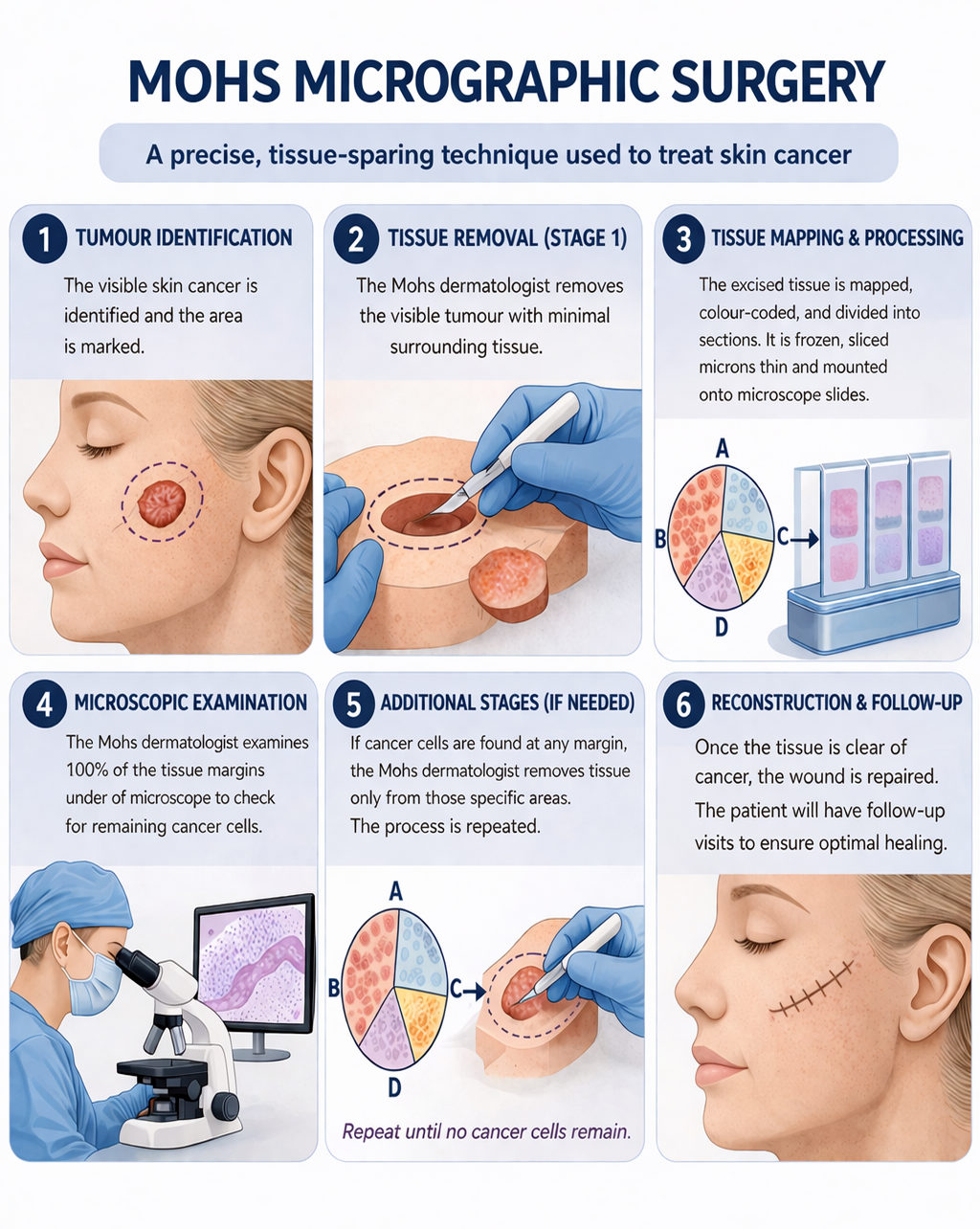
In Mohs surgery, the tumour is removed in a series of stages, and the excised tissue is histologically analysed in the laboratory for cancer cells at each step of the procedure.
“The patient has local anaesthetic infiltrated and the tumour is then de-bulked using a curette or a scalpel, and that will provide us lesional tissue to correlate with the margins,” Dr Bui explains.
“The tumour is excised conservatively in the first stage, with a 45-degree bevel yielding a dome-like tissue specimen. This enables us to flatten out the tissue for mounting onto slides to examine the peripheral and deep margins.
“That gets prepared, inked and colour-correlated to a map of the area on the patient’s skin. This mapping process is critical to enable any residual tumour identified microscopically to be traced back to an exact anatomic location on the patient.”
The tissue is sectioned into smaller blocks, rapidly frozen, and then cut using a cryostat in a horizontal plane into very thin sections, five to seven microns. The sections are then stained using haematoxylin and eosin before being mounted onto microscope slides, and the dermatologist examines the tissue margins for cancer cells.
“Once those slides are processed,” Dr Bui explains, “and, let’s say, the majority of the slides are clear but a small nest of tumour cells remain at the nine o’clock mark, then I’d take another separate stage, just focusing on that nine o’clock margin, and continue until I am able to confirm the tissue is tumour-free.”
In wide excision for a basal cell carcinoma (BCC), the doctor would apply a conventional margin of 3mm to 4mm all the way around the cancer, excise the entire area, close the defect, and refer the tissue for examination by a pathologist.
“An estimation is made as to where the tumour starts and finishes based on macroscopic and dermoscopic inspection,” Dr Bui explains, “and extra surrounding tissue is removed, sacrificing potentially healthy skin in the process of empirically removing tumour and subclinical extension. Definitive pathology results are generally available several days to weeks following the procedure.
“Whereas with Mohs surgery, pathologic examination of the tissue occurs on the day. That’s why a fairly conservative first stage can often be utilised and then allow further tissue removal to be directed by the results seen under the microscope.
“I often explain to patients that the main advantage of Mohs surgery is the conservation of healthy tissue. I am aiming to remove only lesional tissue and stop as soon as the tumour is clear. While we are talking about mere millimetres, these are important to patients when faced with skin cancers in cosmetically sensitive areas such as the nose, lips, around the mouth, eyelids, eyebrows and ears.”
While offering a single, definitive treatment episode, the staged removal of the cancer means it is difficult to predict how long the procedure will take – it can range widely from several hours to most of the day. As a result, patients need to be prepared for this and avoid other conflicting commitments.
“To be fair, though, a reasonable amount of time is related to tissue processing,” he says. “So, it is important that patients bring activities such as books, magazines or puzzles to keep them occupied throughout the day.”
Dr Bui says: “To be recognised as a Mohs specialist in Australia, completion of the four-year dermatology training program is required, followed by an additional rigorous fellowship encompassing surgical skills and pathology.”
There are currently 14 doctors in WA accredited as Mohs specialists by the Australasian College of Dermatologists.
Dr Bui cautions that while Mohs surgery has advantages – even for rare cancers such as sebaceous carcinoma and microcystic adnexal carcinoma – patient circumstances, comorbidities, as well as tumour factors all need to be considered before deciding if Mohs surgery is the most appropriate treatment.
References available upon request.
You're just getting to the good part! Log in to your AMA (WA) member account to continue reading, or join today for full access to exclusive content, member benefits, and more.
Month End Offer is live!
Get up to 40% off on AMAMedius
Sign in using your membership email and date of birth.