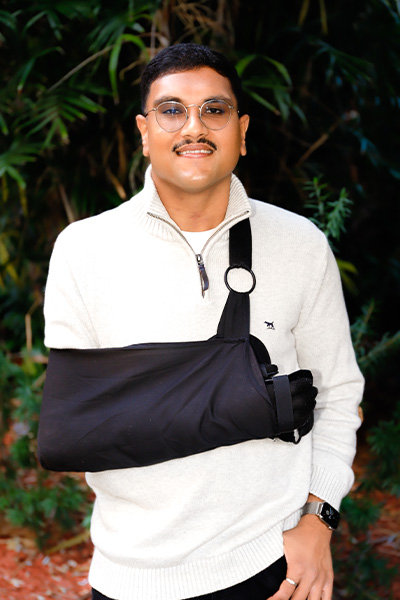
On track, with one arm and a full heart

Even a horrific accident couldn’t have derailed Michael Thomas’ dream of becoming a doctor

Claim EA: Professional Reading CPD hours with AMA CPD Home. Learn more in our helpful article and log your hours.

Dr Michael Thomas at Royal Perth Hospital.

For 17-year-old Kalgoorlie local Michael Thomas, a perfect summer’s day longboarding with friends in the hills of Spearwood (Perth) twisted into a life-changing ordeal when he was then hit by a car. The accident left Michael with serious injuries, including several fractures and a complete tear of the brachial plexus from his spinal cord, rendering spontaneous recovery in his dominant right arm impossible.

Transferred to Royal Perth Hospital’s (RPH) Trauma Unit, Michael recalls sitting in a wheelchair on the pedestrian bridge that connects two blocks of the hospital campus, contemplating his future.

Could a career in medicine, something he’d long dreamed of, still be possible without a functioning right arm? Would he be able to walk the same inspiring path as his parents, both of whom are doctors?

Riddled with doubt, Michael says he didn’t discard his ambitions to become a doctor; but focused instead on completing Year 12 and graduating alongside his incredibly supportive friends.

He achieved this – and subsequent milestones. After Year 12, Michael took a gap year and then moved to Perth from his family home in Kalgoorlie. He learnt how to live independently, all the while working hard with his occupational therapist to develop strength and skill in his non-dominant left hand.

It took him six months to be able to write legibly, and about two years to learn other skills – including all the little things that we take for granted.

Medical school at Curtin University was next on the radar, followed by an internship at RPH.

Since then, Michael has completed rotations across some of the busiest departments in the hospital, been named the RPH Goatcher Intern of the Year, inserted countless cannulas, and undertaken tricky lumbar punctures.

Now in his third year at RPH, he’s already had a strong start to 2026, having just been accepted into Basic Physician Training – one of only 22 doctors to make it through in the State out of the hundreds that apply.

Undecided between specialising in Haematology or Neurology, Michael says he ultimately aims to be the type of doctor who engages with his patients meaningfully and with compassion.

“I want to break out of that algorithmic approach to patient care,” he explains.

“I value that side to the art of medicine where you take the best possible evidence base on how to treat this person; then as a clinician, you adapt it to that patient based on their social and geographical circumstances, and their co-morbidities.”

Read on for more of our interview with the inspiring Michael.
Light-hearted humour also goes down well. I’ve offered quite a few inventive reasons for my arm being in a sling, including a croc attack or doing it just to keep things challenging!

How did you work through the uncertainties that threatened your dream to be a doctor?

In the early days and even in the run up to finishing medical school, I had great doubts about whether I’d make it. But having supportive family and friends who spurred me on to keep trying and who constantly reminded me of the things I’d achieved… this motivated me to remember that things might be difficult, but not impossible.

Do you remember your first lumbar puncture?

Yes, I do, vividly. I was on a Haematology rotation during my fourth term as an intern. I was fortunate to have supportive registrars who assured me they’d talk me through the procedure and be there to assist.

I obviously gave it a lot of thought, and practised on a model before performing it on the patient. My first attempt was successful.

For me, it was a big step in terms of building my confidence and being able to do something challenging, because of the way people supported me.

How do you approach any hesitation expressed by colleagues and patients in relation to your disability?

Taking a minute to help them understand my circumstances is usually the first step. Also, establishing a degree of trust with my supervisors or colleagues is important. But yes, it’s easier with some people and more challenging with others.

As a society, we’re not used to seeing people with different abilities do certain jobs. But on the flipside, I think sometimes patients feel like I relate to them even more in terms of lived experience.

Light-hearted humour also goes down well. I’ve offered quite a few inventive reasons for my arm being in a sling, including a croc attack or doing it just to keep things challenging!

How do you stay mentally strong?

I am fortunate to have a very strong support network in my friends and family. They are always there to listen to what I’m struggling with, and to share ideas. I make sure I keep time for things outside of work, such as staying active, playing golf and travelling, taking an opportunity to reset, and have other things to look forward to.

What is your message to those out there who are grappling with their own disabilities, visible or invisible?

Being ‘differently’ able can be your strength. I think it enables you to empathise with your patients and connect with them on a more personal level. We are humans first, and our profession second.

We build resilience through challenges, and it’s important that we find a good support structure – people who will look out for us, who will recognise when we’re struggling, and whom we feel comfortable talking to about things.

We’re fortunate to live in a world where there are adaptive technologies, and workplaces that are more accommodating of people with different needs and abilities. If you’re determined, persistent and hardworking, you will make it.

I think it makes a big difference for people with disabilities – either hidden or visible – to see others like themselves in jobs they’d like to pursue. If I can use my experience to help others navigate a particular pathway, that’s motivating enough.

We’re fortunate to live in a world where there are adaptive technologies, and workplaces that are more accommodating for people with different needs and abilities. If you’re determined, persistent and hardworking, you will make it.

Start typing and press Enter to search