




UWA Medical School
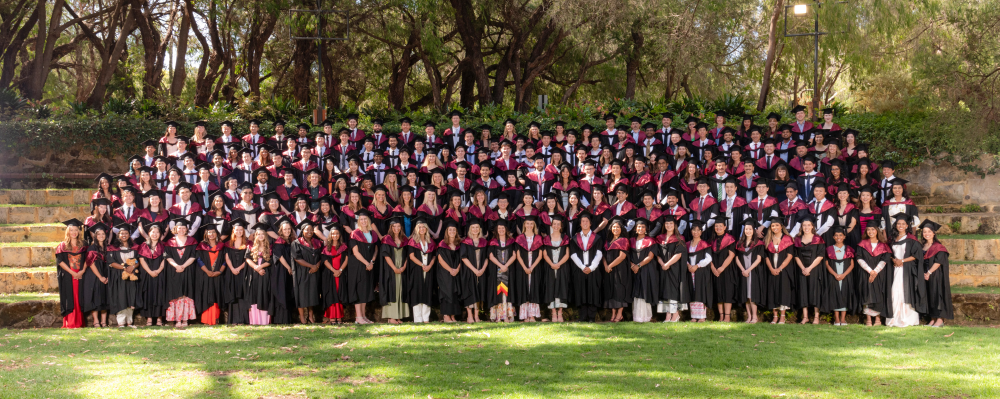
The graduation ceremony for the UWA Medical School was held in Winthrop Hall on Wednesday, 18 December 2024, with 193 students graduating with a Doctor of Medicine, and 57 of those students graduating with Distinction.
It was a special night for the AMA (WA) family, with CEO Dr Bennie Ng the guest speaker at the ceremony.
AMA (WA) President Dr Michael Page received his PhD for a thesis entitled ‘Aspects of cardiovascular risk stratification and management of familial hypercholesterolaemia’.

AMA (WA) Prize Winner and Valedictorian Dr Emilija Mitrovic with AMA (WA) President Dr Michael Page.
AMA (WA) Prize Winner and Valedictorian Dr Emilija Mitrovic was humble and appreciative of WA’s oldest medical school in her speech to the cohort.
“We have all made it here through not only our own determination, but also the sacrifices of our loved ones. I am deeply privileged to have the support of an entire family behind me – cooking, cleaning, and worrying about something called a ‘mortgage’, while I was buried in the depths of LMS and the Therapeutic Guidelines.
I’m aware there are many here today who do not have that advantage. Some of my fellow graduates have raised a family in the last four years. International students have travelled from distant countries alone, adapting to a new culture and language. Many have supported themselves with a full-time job to make ends meet. I admire these individuals immensely and congratulate them on this exceptional achievement.
UWA professors and lecturers are not just incredibly knowledgeable, but also committed to shaping the next generation of doctors. We thank each of you who shared your experience and unwavering belief in our potential, even when we couldn’t correctly demonstrate basic first aid.
It wasn’t all smooth sailing. We’ve been lost in unfamiliar hospitals only to discover our team wasn’t expecting us that day. We’ve endured the pressure cooker of OSCEs, and I personally still jump when I hear a whistle being blown. We’ve stood in operating theatres and tried our best to faint outside of the sterile field. But in the process, we learnt about perseverance and the quiet strength of getting back up each time you stumble.
We have also seen new life being born, held patients’ hands in their moments of despair, and worked alongside the best doctors in Australia. These are singular experiences that very few have undergone.
Today marks the summit of this journey. But we look to future mountains, ready to embrace the challenges ahead. Thank you and congratulations again to the Class of 2024.”
In his speech, Dr Ng reflected on his own journey in medicine and the key aspects of his mindset that shaped his career.
“It is an absolute honour to speak at this significant milestone event. I was the first in my family to attend university. My journey began with my parents, both nurses, who took the bold step to migrate to Perth so that my brother and I could access better education. For me, earning a medical degree from this university was one of the greatest opportunities in the world.

Guest speaker and AMA (WA) CEO Dr Bennie Ng.
Many years ago, I sat exactly where you are now, feeling that same mix of excitement and pride in completing one of the most demanding and prestigious degrees. What I didn’t realise then was the sheer breadth of opportunities this degree offers.
My journey has taken me from general practice in WA, to reforming public hospitals in Hong Kong, and eventually serving as a senior adviser and head of social policy to the Prime Minister of Australia in Canberra. Today, I want to share with you three mindsets that helped me make the most of the freedom and choice this degree will give you.
The first mindset is ‘Seize the opportunity’.
Medical careers are not an orderly queue, nor is our health system even close to being run perfectly. There are opportunities everywhere to make a difference – whether it’s reforming models of care, tackling workforce challenges, or simply providing the best possible care to your patients.
Many of you would envision a lifelong career as a dedicated frontline doctor. I thought so too. But after completing my internship and residency at Fremantle Hospital, opportunities I never expected began appearing.
I went from representing WA GP registrars to becoming a medical educator, holding two board directorships, and later taking on a job as CEO of a national medical body – all while training as a GP. Then came the unexpected: a call from the Health Minister’s office in Canberra asking me to become a health policy advisor.
I had doubts. I wanted to address the problems I saw in general practice and Medicare, and make a difference at a system level. But I’d never studied political science nor joined a political party – the only parties I knew were those in Northbridge! But as I learnt from my parents, the opportunities most worth taking are often the hardest. You have to be bold to avoid regrets.
The second mindset is ‘Adapt your course’.
Many of you may have a clear plan for your career, and that’s great. But life often has other ideas, and external events can shift your trajectory. That’s okay. Listen to yourself, explore what you truly enjoy, and be willing to embrace the unexpected.
People often ask me what I studied to get to this role. The answer might surprise you. I didn’t have an MBA when I became a CEO for the first time. I didn’t have a fellowship in medical administration when I led clinical service planning in Hong Kong. I didn’t have governance qualifications when I first became a board director.
Even when I was headed for a career in hospital administration, I got another call – this time directly from the Prime Minister, asking me to return to Parliament House. My responsibilities extended far beyond health to include aged care, disability, welfare and Indigenous affairs.
At first, I felt underqualified. But here’s the truth: doctors are trained to learn quickly, diagnose problems and manage complex issues. These skills are transferable and highly valued in settings far beyond clinics and hospitals.

World Medical Association Declaration of Geneva (Professional Dedication) Cohort reading led by Dean and Head of the UWA Medical School Dr Brendan McQuillan, Dr Tricea Tang, Dr Narendra Gammanpila, and AMA (WA) President Dr Michael Page.
The third mindset is ‘Show your gratitude’.
Like elite sports, building a career is a team effort. You wouldn’t be here today without the sacrifices and support of family, friends and loved ones. Treasure and build on these relationships. They’ll be there to celebrate your wins, guide you when you are at the crossroads, and lift you up when things are tough.
While earning my medical degree was a moment of immense pride, serving as CEO of the AMA (WA) – our State’s peak medical body – has been an even greater privilege. My father passed away five years ago, and his loss was a turning point that brought me back to Perth for this role. I remain forever grateful for my parents’ courage and sacrifice that made my journey possible.
So, graduands, as you stand at the cusp of your next chapter, I leave you with this:
It’s easy to sit back and be a critic. As junior doctors, you will see human error, questionable decisions, systems in need of reform, and avoidable poor outcomes. But making changes and solving these challenges takes courage. You need to be bold – to seize opportunities, adapt your course, and show gratitude for those around you.
As Theodore Roosevelt once said: “It is not the critic who counts, but the one in the arena; whose face is marred by dust and sweat and blood; who strives valiantly… and who, at the worst, if he fails, at least fails while daring greatly.”
You have the power to write your own story and define success on your own terms. I welcome you as colleagues and fellow members of this extraordinary profession. Congratulations, and thank you.”