Dr Lisa Sorger

Radiologist, AMA (WA) Private Practice Group member

Claim EA: Professional Reading CPD hours with AMA CPD Home. Learn more in our helpful article and log your hours.

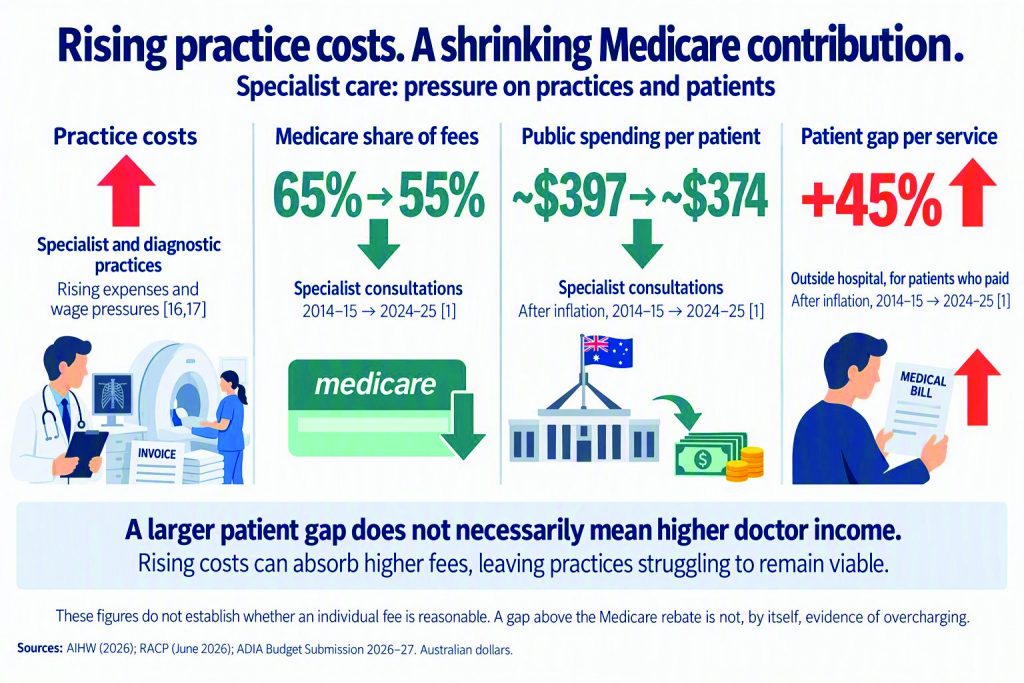
A Medicare card does not guarantee affordable specialist care. The cost of running specialist and diagnostic practices is rising, while Medicare’s contribution per specialist patient has fallen after inflation.

Patients can pay more while practices struggle to meet their bills. That is a funding and access problem, not automatically evidence of doctors enriching themselves.1,16,17

The AMA supports doctors’ right to set their own fees; clinical autonomy includes professional and financial autonomy. The AMA’s Fees List, indexed annually on 1 November, provides recommended fees as a guide, but these are not mandatory.

The AMA acknowledges community concern about medical out-of-pocket costs and has been actively engaged in government transparency initiatives. The emphasis is on clear fee communication and sound informed financial consent practice – ensuring patients understand what they will be charged before they commit to treatment, enabling genuine financial consent and informed decision-making.

Fees pay for staff, premises, equipment, insurance, administration and clinical work. They are practice revenue, not the doctor’s take-home income. Rising overheads, amidst a cost-of-living crisis, absorb fees and squeeze the margin needed to keep a service open. The Royal Australasian College of Physicians (RACP) reports rising practice expenses; diagnostic imaging providers warn that inadequate rebates and wage pressures threaten service viability.16,17

The rebate freeze was a policy choice by the Federal Government; indexation for specialist attendances resumed only in July 2018. Resuming increases does not automatically restore lost purchasing power. When indexation lags costs, the shortfall grows. The fall in Medicare’s share has several causes, but funding policy cannot escape scrutiny.10,15

Government scrutiny of excessive specialist fees is legitimate. It must also examine whether its own contribution makes necessary care affordable. The Australian Bureau of Statistics (ABS) records patients delaying or foregoing specialist care because of cost.2,13

What universal coverage buys

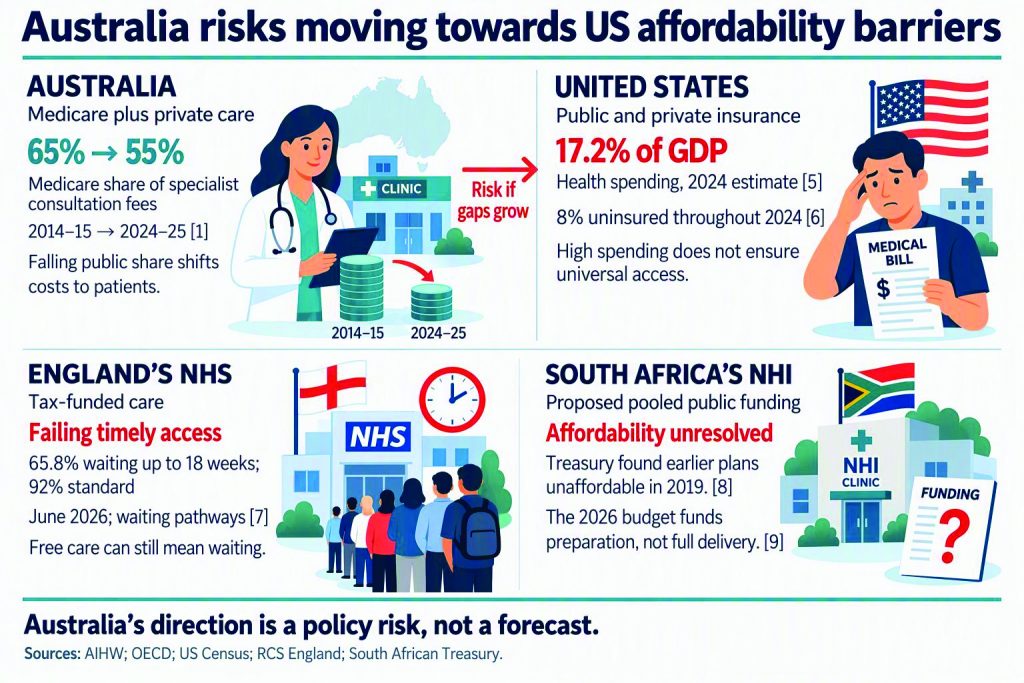
Universal coverage means needed, effective care without financial hardship. Different countries fund that promise differently. None makes care costless: people pay through taxes, insurance or personal spending. Australia risks US-style affordability barriers if Medicare leaves patients carrying more of the bill.3

The barrister comparison

The NSW Attorney General sets rates for counsel engaged by government. These govern public purchasing, not every private client’s bill. Similarly, the Medicare schedule determines the public contribution, not the cost of delivering every specialist service.4

Unlike a privately retained barrister’s client, an eligible private medical patient receives a public subsidy. Government has a legitimate interest in affordability and a responsibility to fund its contribution adequately. Judging doctors solely against a rebate that government controls conceals half the transaction.

When care depends on time

Paediatrics, psychiatry and geriatrics depend heavily on consultation time. Longer-consultation items exist, but rebates do not increase with every extra minute: qualifying 50-minute and 70-minute psychiatry consultations attract the same scheduled benefit. Consultation-based practices may have little procedural income to offset shortfalls. Calling the resulting gap greed avoids the funding question.11,16

For families unable to obtain timely public care, the choice can be a private gap or a long public wait. Patients pay in money or time. Additional privately funded options are ethically defensible only when everyone can obtain timely, effective essential care.16

Why transparency cannot repair an inadequate rebate

Necessary care often has inelastic demand: patients have limited scope to reduce their need when prices rise. Someone needing a biopsy cannot simply shop as if buying an optional service. Cost sharing can mean hardship or delayed treatment.12

Patients deserve clear fees, rebates, gaps, waiting times and relevant quality information before referral. Transparency can help where alternatives exist; it cannot raise an inadequate rebate or create another local specialist.21,22

The Independent Health and Aged Care Pricing Authority uses cost data to set an annual efficient price for public hospital care. Specialist rebates need a comparable published benchmark, adapted to community practice: time, complexity, overheads and work outside appointments. Commission independent costing; publish how rebates compare; and index them against those costs. Monitor increases to ensure patients benefit. Excessive fees still warrant scrutiny.14

Who is blocking access? When Medicare underprices necessary care, government shifts the shortfall on to patients and practices. Neither can absorb it indefinitely. Affordable access requires public funding that supports the real cost of sustainable care.


Dr Sorger is founder of myradiologist.ai and Medical Director for Prenuvo Australia, with commercial interests in diagnostic imaging and clinical artificial intelligence. She writes in a personal capacity.

References available on request.

Start typing and press Enter to search