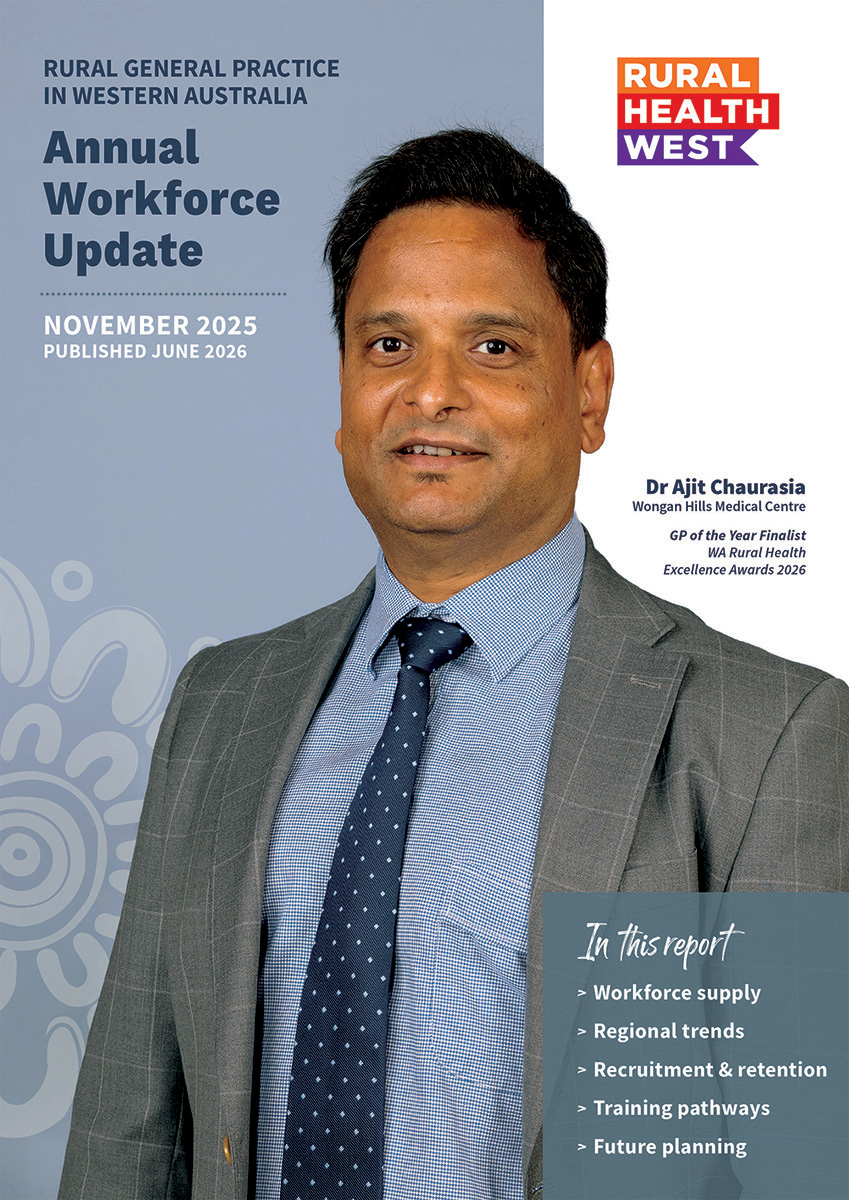
The latest annual workforce survey from Rural Health West shows there are 1,067 GPs servicing communities in the South-West, Great Southern, Mid-West, Wheatbelt, Goldfields, Pilbara and Kimberley regions – an increase of 58 doctors from the previous year. This 5.7% growth represents the largest annual increase in rural GP numbers in more than a decade.
That number includes 30 more resident GPs living and working in rural communities, reversing the trend of an increasing reliance on fly-in, fly-out and drive-in, drive-out models.
The Rural General Practice in Western Australia: Annual Workforce Update, a survey snapshot of GP numbers as at November 2025, also points to improving workforce stability.
Overall GP turnover is steady at 13.2%, continuing a longer-term downward trend that suggests more doctors are choosing to remain in regional communities.
In the Goldfields, GP turnover is below 10% for the first time in a decade, while the Pilbara has had a significant turnaround, gaining 11 GPs (14.3% growth), after several years of exceptionally high turnover.
There is also an increase in the number of female GPs, who now represent almost 50% of the workforce. There are an extra 41 female GPs (8.5% growth) compared to 2024, taking the total to 526, and continuing an upward trend since Rural Health West started reporting annually in 2001.
“Behind every one of these numbers is a doctor providing care to a rural community, supporting patients, and helping to ensure people can access healthcare closer to home,” Rural Health West CEO Professor Catherine Elliott said.
“It’s particularly encouraging to see growth in resident GPs, because doctors who live in their communities become part of the fabric of those towns. They support local schools, businesses and sporting clubs, supervise future health professionals, and provide the continuity of care that rural patients value.”
Prof Elliott said these results reinforced the importance of investing in workforce retention initiatives. One such initiative is Rural Health West’s statewide network of Health Professionals Networks which connect more than 5,500 health professionals across regional WA through education, professional development, networking and peer support.
“Retention doesn’t happen by accident,” Prof Elliott said.
“We consistently hear that health professionals who feel connected to their colleagues and communities are more likely to remain working in rural areas. That’s why investment in initiatives such as Health Professionals Networks is so important – they help build the professional and personal connections that encourage people to stay.”
The report says there are 217 community general practices as at 30 November 2025, nine greater than in 2024. Of these, 140 were group practices (64.5% of total), 50 were solo practices (23%) and 27 (12.4%) were Aboriginal Community Controlled Health Services.
There were 176 rural GP proceduralists recorded, one fewer than in 2024. Over the past 10 years, the proportion of proceduralists in the workforce has fallen from 22.9% in 2015 to 16.5% in 2025.
The report says the number of rural GP proceduralists performing more than one procedure has also decreased markedly in the past two decades. In 2007, there were 14 GPs (7.3% of proceduralists) who practised all three procedures – anaesthetics, obstetrics and general surgery – and 68 (35.4%) who practised two procedures. In 2025, only one GP (0.6% of proceduralists) practised all three procedures, and only 10 (5.7%) practised two.
Prof Elliott said Rural Health West continues to hear concerns about the financial viability of GP services in many smaller communities. Local governments are increasingly stepping in to provide financial and in-kind support to help maintain access to healthcare.
“Healthcare funding is not traditionally a local government responsibility, and there is growing recognition that more sustainable long-term solutions are needed,” she said.