Breakthrough drug candidate could change the lives of millions

A first-in-class drug candidate for heart disease that has been shown to reduce plaque in arteries by up to 50% is aiming to start clinical trials in Perth next year

Claim EA: Professional Reading CPD hours with AMA CPD Home. Learn more in our helpful article and log your hours.

After more than a decade of research and development, successful experiments in mice, and promising testing on human surgical tissue, ATH01 is moving towards a Phase 1 clinical trial to see if this first-in-class drug candidate can clear arterial plaque in people like it does in the lab.

“If it works, it’s a gangbuster,” says longtime AMA (WA) member Professor Peter Leedman AO, chief executive of the Harry Perkins Institute of Medical Research where ATH01 was developed.

In the lab, it’s been shown to remove up to 50% of plaques in a mouse model without any adverse effects.

Juliana Hamzah and Shirley Jansen at the Perkins.

The next step in the journey to commercialisation of the drug is to run toxicology tests to reassure that it’s safe, before moving to a Phase 1 human trial in 2027.

The team pushing ahead with the potentially life-changing research project is led by Perkins scientist Juliana Hamzah, and clinician Shirley Jansen who heads the Department of Vascular and Endovascular Surgery at Sir Charles Gairdner Hospital.

Associate Professor Hamzah, who engineered the creation of ATH01, explains that it works by safely activating the body’s natural clearance mechanism.

“ATH01 is a combination or integration of two molecules,” she says.

“One is what we call the active ingredient, and that is a natural human protein that sits in the arterial wall and helps arterial wall function by, for example, trying to control blood pressure; trying to make our arterial wall a lot stronger in order to pump the blood from the heart.

“ Once ATH01 enters the arterial wall and binds to atherosclerotic plaque, it activates the cells in the arterial wall to metabolise and dissolve the complex lipids.

“But what happens in the arterial wall that has a lot of lipids, is that the protein that’s supposed to be there is missing. What ATH01 does is replenish or reinstate the protein for it to function.

“We engineered that protein by fusing it to a homing molecule that, once it enters the blood circulation, can penetrate across the arterial wall and bind to areas that have high-cholesterol, high-lipid complexes. This is like a sensor molecule that brings the active ingredient directly to the target.

“So, once it enters the arterial wall and binds to atherosclerotic plaque, it activates the cells in the arterial wall to metabolise and dissolve the complex lipids.”

Professor Jansen AM, who is also Director of the Heart and Vascular Research Institute at Perkins, explains why that targeting capability is crucial.

“It’s going to act wherever there’s atherosclerosis,” she says. “It doesn’t harm good cholesterol or healthy cell membranes. It binds to the problem, the pathology; and that’s where it has its action and causes the cells to metabolise the lipids.

“That’s going to be much better than having an angioplasty or a balloon dilatation of a narrowed artery, which is just going to push the narrowing out of the way; or a surgical bypass where we can stitch in a conduit to go around the blockage; or tablets we can take to prevent the problem. While those are all of significant value right now, they’re not going to have the kind of impact, potentially, that this agent has.”

In the early days of research, the project wasn’t getting external financial support – they missed out on medical grant funding twice a year for several years running – but seed funding from the State Government’s Future Health Research and Innovation Fund led to several federal funding supports.

Part of the funding problem was that the research findings about the ability of ATH01 to clear plaque, cholesterol and lipids from the arterial wall seemed “too good to be true”.

“We were concerned,” says Prof Jansen. “We questioned it, thinking this is too good to be true. There must be something wrong. We’ve got to do the experiment again. But it still showed the same result.”


“ We questioned it, thinking this is too good to be true. There must be something wrong. We’ve got to do the experiment again. But it still showed the same result.

Funding is still an issue for the ongoing clinical trials. But a spin-off company from the Perkins, Atherid Therapeutics, which is pursuing commercialisation of ATH01, has received financial backing from WA’s Health Translation Group – a not-for-profit created by the Perkins, Perron and Lions Eye Institutes to further medical research in WA and turn promising results into real-world application; and hopefully create financial returns to fund more research.

That has allowed the project to start working through the best way to manufacture ATH01 at scale at a Good Manufacturing Process operation, run by Bridgewest Group’s BioCina, operating in Adelaide and WA.

While looking to the future, the project team are progressively pursuing ongoing research to better understand the accumulation of plaque in arteries and why some areas are more lipid-rich than others.

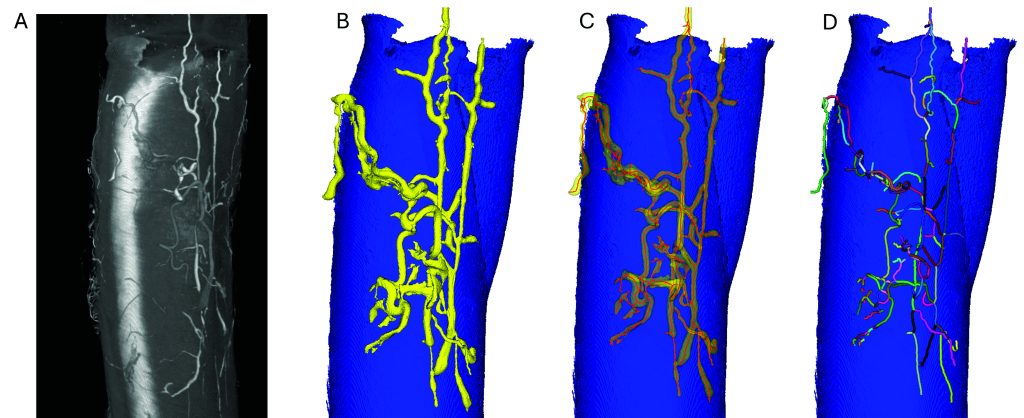
Enhanced imaging of porcine thoracic aorta vasa vasorum with contrast micro-computed tomography.
Zhao et al, Journal of Anatomy, Feb 2025

 “There are some mechanical links to where atherosclerosis develops,” Prof Jansen explains. “It tends to have a prevalence in vessel origins and branch points, or where an artery goes through a muscle tunnel and there’s movement of the muscle on the artery all the time, for example.

“We have a PhD student using micro-CT to inject samples of blood vessels to make a cast into the vasa vasorum, which are the little micro vessels that supply the wall of the artery itself with oxygen and remove nutrients.

“We’re looking at the links between the location of the vasa vasorum, which is concentrated at branch point origins, and atherosclerosis, which is concentrated there too. It’s also concentrated at areas of extra mechanical impact on the vessel.

“For example, the superficial femoral artery in the thigh goes through a tunnel in the muscle, so the artery is constantly being injured. Are those micro vessels being injured on a repetitive level, and is that allowing the lipids to leak out into the wall?”

The project team leaders have three continuing lines of inquiry into the disease: the mechanics, the biology and the drug’s potential, all running together.

“ Over the next five years, we’ll be advancing ATH01 development while, at the same time, learning much more about human plaque biology.

“This may not be a magic bullet that works for everyone or cures everything. I don’t think that’s the case, but we need to better understand which patients are most likely to benefit from treatments targeting plaque,” A/Prof Hamzah says.

“We need to understand the disease context a lot better, because human plaques are far more complex. I would say over the next five years, we’ll be advancing ATH01 development while, at the same time, learning much more about human plaque biology.”

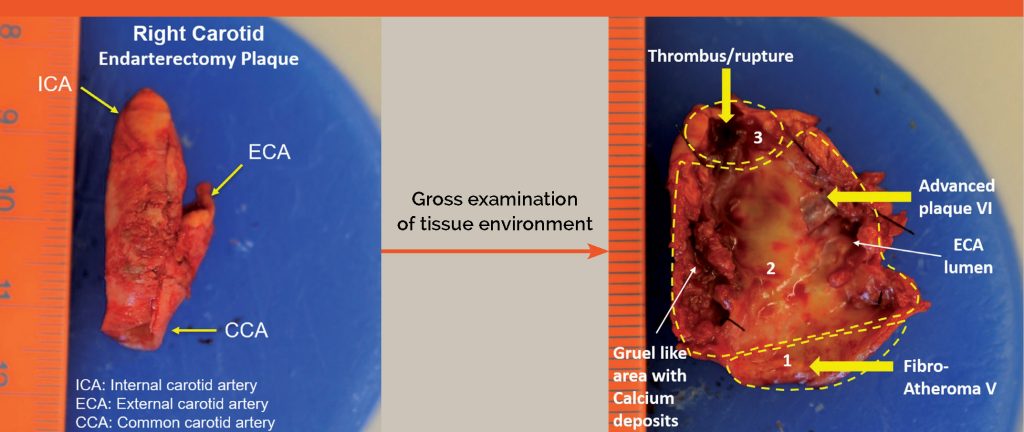
Atherosclerosis supposedly just happens on the inner lining of the artery walls, in the intima. However, the research team has found atherosclerosis in the media, in the middle of the arteries.

“We know that a third of patients who have plaques removed from the neck have medial atheroma,” Prof Jansen says. “So, there’s something different going on. Is it related to mechanical stress? There’s a lot we don’t understand.

A patient specimen collected following surgery performed by Prof Jansen’s team at Sir Charles Gairdner Hospital.
Credit: Dr Hanane Belhoul-Fakir

“And the last part of that story, if it’s not complicated enough, is that people are becoming more and more interested in not only the vessels of the vessels, but the layer outside of that. So, the connective tissue that is around the vessel is now known as the fourth layer of the vessel wall because it has nerves, blood vessels, lymphatics, and is an active biological layer around the vessel.

“We see responses in the artery when we puncture it to do angiography, for example. So, mechanics/injury is important for us to understand from a bioengineering point of view, and how that might link to the lipid profiles in the plaque.”

Under the regulatory framework, ATH01 will be initially tested in the Phase 1 clinical trial on healthy people who have no history of cardiovascular disease and no appreciable plaque burden, to check the safety profile and any side effects.

The research team is then hoping to run a Phase 1b test on people who have familial hypercholesterolemia (FH) and patients with peripheral arterial disease (PAD) who have a heavy plaque burden and are facing amputation as their only option.

KEY FACTS

  • Every year in Australia, atherosclerosis results in about 57,000 heart attacks, 56,000 strokes, 8,000 limb amputations, and 200,000 medical procedures – equating to $17 billion of health expenditure.
  • Cardiovascular disease is responsible for a quarter of all deaths in Australia – that’s one person every 12 minutes.
  • About 100,000 Australians are living with the genetic condition of familial hypercholesterolemia (FH), causing premature heart disease, but only about 10% of them know they have it.

Start typing and press Enter to search