Archives

  • April 2026
  • March 2026
  • February 2026
  • January 2026
  • December 2025
  • November 2025
  • October 2025
  • September 2025
  • August 2025
  • July 2025
  • June 2025
  • May 2025
  • April 2025
  • March 2025
  • February 2025
  • August 2024
  • July 2024

Categories

  • 2025 MEDICAL CAREERS EXPO
  • 2025 RURAL HEALTH AWARDS
  • 2026 MEDICAL CAREERS EXPO
  • ADVERTORIAL
  • ADVERTORIAL – MDA NATIONAL
  • ADVERTORIAL – NORTH METROPOLITAN HEALTH SERVICE
  • ADVERTORIAL – SILVERCHAIN
  • AGED CARE
  • AMA (WA) PRACTICE GROUPS
  • AMA FINANCIAL SERVICES
  • AMA25 CONFERENCE
  • AMBULANCE RAMPING
  • ANNUAL GENERAL MEETING
  • AUSTRALIA DAY HONOURS
  • AUTHOR INTERVIEW
  • CARE IN ACTION
  • CLASSIFIEDS
  • CLINICAL EDGE
  • COLORECTAL CANCER
  • COMBAT SPORTS
  • COMMENT
  • CONGRATULATIONS
  • COVER STORY
  • COVER STORY – FIRST NATIONS HEALTH
  • COVER STORY – SURGERY & ANAESTHESIA
  • CPD HOME
  • DHASWA
  • DOCTORS IN TRAINING
  • DR YES
  • DRIVE
  • FAMILY LAW
  • FEATURE – DERMATOLOGY
  • FEATURE – OPHTHALMOLOGY
  • FEATURE – PATHOLOGY
  • FEATURE – RESEARCH PROFILE
  • FEATURE – WOMEN & BABIES
  • FROM THE EDITOR
  • GRADUATION CEREMONIES
  • HEALTH INFRASTRUCTURE
  • HEALTH LEADERSHIP
  • HEALTH WATCH
  • HOSPITAL HEALTH CHECK (HHC) 2025
  • IMG DIARY
  • INDUSTRIAL RELATIONS
  • INTERN ORIENTATION WEEK
  • INTERNSHIP
  • MEDBALL25
  • MEDIA MATTERS
  • MEDICO-LEGAL MATTERS
  • MEET THE COUNCILLOR
  • MEMBER BENEFITS
  • MEMBERS SOIREE
  • MENTAL HEALTH FEATURE
  • MINISTER'S MILESTONE
  • NEWS
  • ON THE SHELF
  • ONLINE SAFETY
  • OPINION
  • OPINION – RACGP
  • OUT & ABOUT
  • POLICY
  • POLICY – ERIDEABLES
  • PRACTICE MATTERS
  • PRESIDENT'S DESK
  • PROFESSIONAL NOTICES
  • PROFILE
  • PUBLIC HEALTH – WAAC
  • RESEARCH
  • RURAL PRACTICE
  • SLEEP SURVEY
  • SOCIAL MEDIA LEGISLATION
  • STATE BUDGET 2025-26
  • STUDENT SPEAK
  • THE LAST WORD
  • TRANSPLANT MILESTONE
  • VALE
  • WHAT'S ON
  • WINE

Advertisment

http://Advertisment

Newsletter

  • Current Edition
  • Previous Editions
    • February – March 2026
    • December 2025 – January 2026
    • October – November 2025
    • August – September 2025
    • June – July 2025
    • Older Editions
  • Advertise with us
  • AMA (WA) Homepage
  • Current Edition
  • Previous Editions
    • February – March 2026
    • December 2025 – January 2026
    • October – November 2025
    • August – September 2025
    • June – July 2025
    • Older Editions
  • Advertise with us
  • AMA (WA) Homepage
Back To Home
Previous Post
An advocate for change
Next Post
They have their eye on an even bigger prize
COVER STORY - FIRST NATIONS HEALTH

Drawing another line in the sand on contaminated drinking water

Researchers are testing for heavy metal contaminants in “baby” teeth that might explain the higher incidence of disease in remote WA communities

Claim EA: Professional Reading CPD hours with AMA CPD Home. Learn more in our helpful article and log your hours.

An Australian-first study is aiming to identify childhood exposure to environmental contaminants in regional and remote Indigenous WA communities by testing “baby” teeth.

The Heavy Metal Tooth Fairy project will collect 125 deciduous teeth from Aboriginal communities and compare them with 125 teeth from Perth children using geochemical analysis.

The project team, led by Kalgoorlie-based paediatrician Christine Jeffries-Stokes AM, is working on the hypothesis that the teeth of children in regional and remote communities will have higher levels of heavy metals than their metropolitan counterparts because they use groundwater for drinking.

The new research builds on the results of the Western Desert Kidney Health Project led by Dr Jeffries-Stokes and her sister-in-law, senior Wongutha, Mulba-Ngadu and Anagu woman
Dr Annette Stokes AM, from 2007 to 2014. This groundbreaking study found that nitrate-contaminated drinking water was a contributing factor to higher-than-expected rates of kidney disease and type 2 diabetes in the Goldfields.

“That raised the possibility of other contaminants in the drinking water as well, and we’ve not been very successful in getting information about that,” Dr Jeffries-Stokes explains.

“But we formed a collaboration with the UWA Hydrogeology team, particularly Sarah Bourke, and the School of Human Sciences, with Caitlin Wyrwoll. And we’ve been working together for a few years now on how we might progress all this.

“ We know that children in all these remote areas from Kalgoorlie and across to the border have higher rates of some diseases. So the next step would be to look at whether there’s any correlation between these toxic metal exposures or heavy metal exposures and the patterns of disease we see.

“We came up with the idea of looking at teeth to see if there’s any evidence of exposure to heavy metals. People have looked at teeth before, like after Chernobyl, but not in this way. Primary school kids across the desert and everywhere else are losing lots of teeth, and we thought this might be a neat way to use them and get information if we can. We’ve done a pilot with 10 teeth, and it looks like it’s going to work.”

The research effort, a sub-project of The Kids Institute ORIGINS program, is supported by the Stan Perron Charitable Foundation, Glencore’s Minara Community Foundation, the WA Health Department, and the University of WA’s Rural Clinical School.

The project has received various ethics approvals, including from the West Australian Aboriginal Health Ethics Committee, with one final approval pending; and the researchers have enlisted the support of about 27 schools and communities that are keen to take part.

The school children and community members will be involved in a citizen science project, in which they will be shown how to test drinking water for contamination.

“They’ll be testing the water and sending us samples,” says Dr Jeffries-Stokes, “and we’ll also be doing an education project where we teach the kids in schools about where their drinking water comes from, how to make a model of the water cycle, and simple methods of purifying the water. We will also develop their knowledge and an interest in science.”

As a school project, the children will also be tasked with tracing their family history.

“They’ll make a poster and interview their family members to find out where they’ve lived,” Dr Jeffries-Stoke explains, “because if we do find things in the teeth, we need to then work out where those exposures might have occurred.”

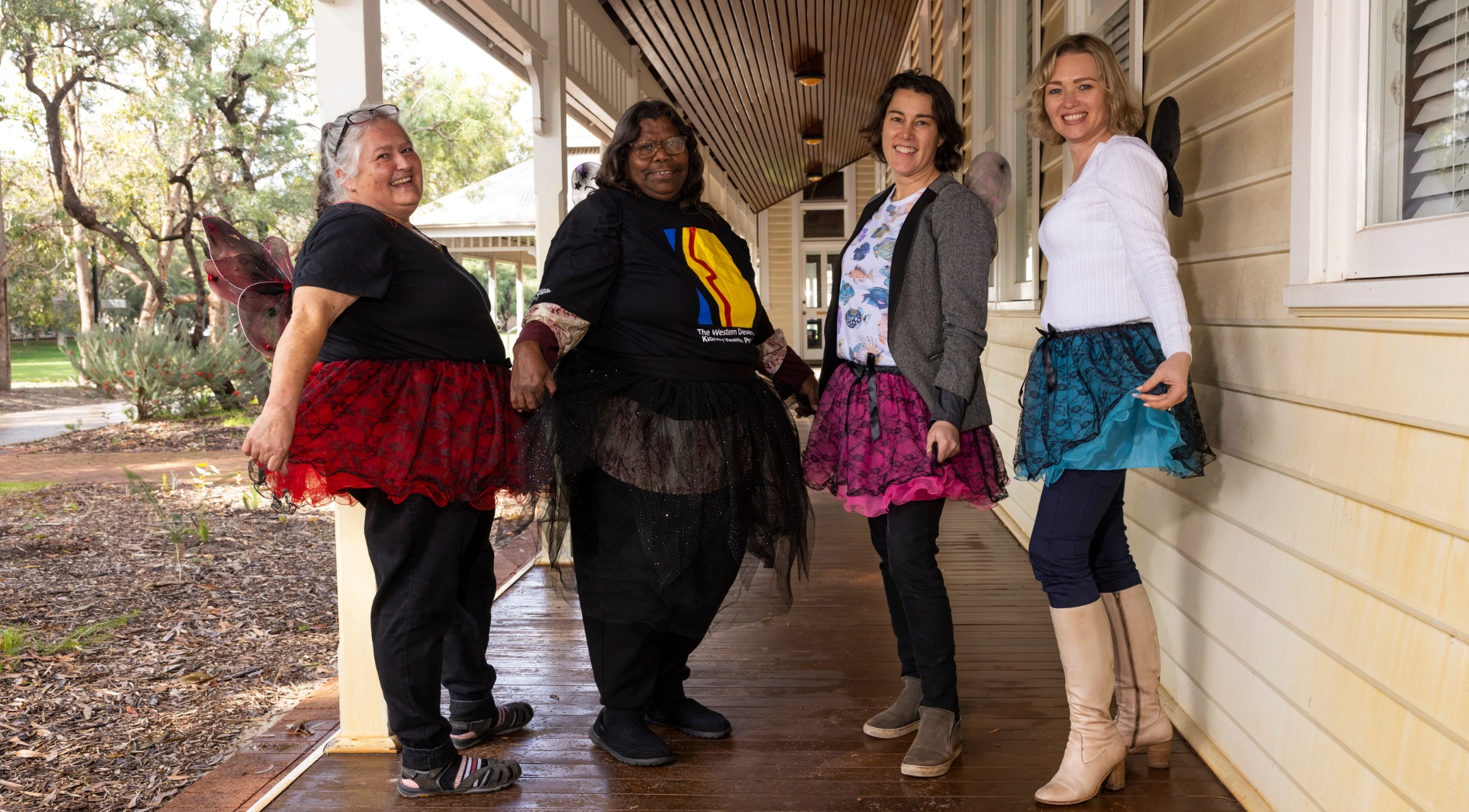
Project team members: Dr Christine Jeffries-Stokes AM, Dr Annette Stokes AM, Dr Sarah Bourke and Professor Yulia Shiikha at UWA.

As the team did with the Western Desert Kidney Health Project, they organised for a group of Goldfields school children to create a “sand animation” promotional video that will be launched shortly on Facebook and YouTube.

“It uses the ancient method of teaching, which is called milbindi. It’s the way Aboriginal people have taught for millennia, by drawing in the sand, the dirt, parna. So, we’re using that to tell the story about the project, what we’re doing, and why we’re doing it,” she says.

The comparison teeth from Perth school children will be provided by the ORIGINS program.

“They already have those teeth,” Dr Jeffries-Stokes explains. “They have a cohort of 10,000 children, and we will match the teeth by comparable age and sex.”

The project team’s hypothesis is that there will be differences in heavy metal contamination between the two sets of teeth.

“We hopefully will see differences,” Dr Jeffries-Stokes says, “but if we don’t, it’s also useful information – that children are not getting significantly different exposures from the environments out here, which would be great and reassuring.

“But if we show they are, that becomes very important; because we then need to protect them. We know that children in all these remote areas from Kalgoorlie and across to the border have higher rates of some diseases, and so the next step would be to look at whether there’s any correlation between these toxic metal exposures or heavy metal exposures and the patterns of disease we see.

“We don’t know whether environmental exposures are a factor or not, but it would be nice to be able to say yes, they seem to be; or no, they don’t, and we can focus our efforts on other areas of research.


As the team did with the Western Desert Kidney Health Project, they organised for a group of Goldfields school children to create a “sand animation” promotional video that will be launched shortly on Facebook and YouTube.

“It uses the ancient method of teaching, which is called milbindi. It’s the way Aboriginal people have taught for millennia, by drawing in the sand, the dirt, parna. So, we’re using that to tell the story about the project, what we’re doing, and why we’re doing it,” she says.

The comparison teeth from Perth school children will be provided by the ORIGINS program.

“They already have those teeth,” Dr Jeffries-Stokes explains. “They have a cohort of 10,000 children, and we will match the teeth by comparable age and sex.”

The project team’s hypothesis is that there will be differences in heavy metal contamination between the two sets of teeth.

“We hopefully will see differences,” Dr Jeffries-Stokes says, “but if we don’t, it’s also useful information – that children are not getting significantly different exposures from the environments out here, which would be great and reassuring.

“But if we show they are, that becomes very important; because we then need to protect them. We know that children in all these remote areas from Kalgoorlie and across to the border have higher rates of some diseases, and so the next step would be to look at whether there’s any correlation between these toxic metal exposures or heavy metal exposures and the patterns of disease we see.

“We don’t know whether environmental exposures are a factor or not, but it would be nice to be able to say yes, they seem to be; or no, they don’t, and we can focus our efforts on other areas of research.

“ We’ll be doing an education project where we teach the kids in schools about where their drinking water comes from, how to make a model of the water cycle, and simple methods of purifying the water. We will also develop their knowledge and an interest in science.

“If we do find evidence, it can be used to advocate for better filtration or better quality drinking water, and it will also help us understand the patterns of disease we’re seeing, particularly things like autism spectrum disorder, which we’re encountering massive increases in diagnosis for – but also for lifelong risk, like for the risk of diabetes, kidney disease, and needing amputations, which we have found may be related to arsenic exposures. This could happen from the water or from the dust, particularly in areas where there are gold deposits.

“It’s fairly well established that chronic arsenic exposure can cause what we call peripheral neuropathy. So, the nerves, particularly in your feet and legs, start to die off; you lose the feeling in your feet and legs, and get reduced blood flow to those areas. That can result in the need for amputations which, in fact, is a major problem in remote areas and was always thought to be due to type 2 diabetes.

“That’s probably a factor, but usually with type 2 diabetes you shouldn’t need an amputation until very late in the disease; whereas we’ve seen quite young people needing amputation. The rate of amputation for people from remote areas is very much higher than for those in urban areas.”

The Heavy Metal Tooth Fairy project is seeking more funding for their research, particularly to support a parallel study of dust contamination.

For further information, send an email to christine.jeffries-stokes@rcswa.edu.au.

Save the article
Previous Post
An advocate for change
Next Post
They have their eye on an even bigger prize
Medicus
© 2026 Medicus - All Rights Reserved.

Start typing and press Enter to search

UNLOCK FULL ACCESS TO MEDICUS

You're just getting to the good part! Log in to your AMA (WA) member account to continue reading, or join today for full access to exclusive content, member benefits, and more.

Month End Offer is live!

Get up to 40% off on AMAMedius

AMA (WA) MEMBER ONLY ACCESS

Sign in using your membership email and date of birth.

If you are experiencing issues, please contact the AMA (WA) membership team via email membership@amawa.com.au