Archives

  • April 2026
  • March 2026
  • February 2026
  • January 2026
  • December 2025
  • November 2025
  • October 2025
  • September 2025
  • August 2025
  • July 2025
  • June 2025
  • May 2025
  • April 2025
  • March 2025
  • February 2025
  • August 2024
  • July 2024

Categories

  • 2025 MEDICAL CAREERS EXPO
  • 2025 RURAL HEALTH AWARDS
  • 2026 MEDICAL CAREERS EXPO
  • ADVERTORIAL
  • ADVERTORIAL – MDA NATIONAL
  • ADVERTORIAL – NORTH METROPOLITAN HEALTH SERVICE
  • ADVERTORIAL – SILVERCHAIN
  • AGED CARE
  • AMA (WA) PRACTICE GROUPS
  • AMA FINANCIAL SERVICES
  • AMA25 CONFERENCE
  • AMBULANCE RAMPING
  • ANNUAL GENERAL MEETING
  • AUSTRALIA DAY HONOURS
  • AUTHOR INTERVIEW
  • CARE IN ACTION
  • CLASSIFIEDS
  • CLINICAL EDGE
  • COLORECTAL CANCER
  • COMBAT SPORTS
  • COMMENT
  • CONGRATULATIONS
  • COVER STORY
  • COVER STORY – FIRST NATIONS HEALTH
  • COVER STORY – SURGERY & ANAESTHESIA
  • CPD HOME
  • DHASWA
  • DOCTORS IN TRAINING
  • DR YES
  • DRIVE
  • FAMILY LAW
  • FEATURE – DERMATOLOGY
  • FEATURE – OPHTHALMOLOGY
  • FEATURE – PATHOLOGY
  • FEATURE – RESEARCH PROFILE
  • FEATURE – WOMEN & BABIES
  • FROM THE EDITOR
  • GRADUATION CEREMONIES
  • HEALTH INFRASTRUCTURE
  • HEALTH LEADERSHIP
  • HEALTH WATCH
  • HOSPITAL HEALTH CHECK (HHC) 2025
  • IMG DIARY
  • INDUSTRIAL RELATIONS
  • INTERN ORIENTATION WEEK
  • INTERNSHIP
  • MEDBALL25
  • MEDIA MATTERS
  • MEDICO-LEGAL MATTERS
  • MEET THE COUNCILLOR
  • MEMBER BENEFITS
  • MEMBERS SOIREE
  • MENTAL HEALTH FEATURE
  • MINISTER'S MILESTONE
  • NEWS
  • ON THE SHELF
  • ONLINE SAFETY
  • OPINION
  • OPINION – RACGP
  • OUT & ABOUT
  • POLICY
  • POLICY – ERIDEABLES
  • PRACTICE MATTERS
  • PRESIDENT'S DESK
  • PROFESSIONAL NOTICES
  • PROFILE
  • PUBLIC HEALTH – WAAC
  • RESEARCH
  • RURAL PRACTICE
  • SLEEP SURVEY
  • SOCIAL MEDIA LEGISLATION
  • STATE BUDGET 2025-26
  • STUDENT SPEAK
  • THE LAST WORD
  • TRANSPLANT MILESTONE
  • VALE
  • WHAT'S ON
  • WINE

Advertisment

http://Advertisment

Newsletter

  • Current Edition
  • Previous Editions
    • February – March 2026
    • December 2025 – January 2026
    • October – November 2025
    • August – September 2025
    • June – July 2025
    • Older Editions
  • Advertise with us
  • AMA (WA) Homepage
  • Current Edition
  • Previous Editions
    • February – March 2026
    • December 2025 – January 2026
    • October – November 2025
    • August – September 2025
    • June – July 2025
    • Older Editions
  • Advertise with us
  • AMA (WA) Homepage
Back To Home
Previous Post
Aboriginal voices helping shape rural health programs
Next Post
Drawing another line in the sand on contaminated drinking water
COVER STORY - FIRST NATIONS HEALTH

An advocate for change

Award-winning doctor Daniel Hunt is proud of his role in improving the delivery of safe and culturally appropriate healthcare to Aboriginal and homeless patients

Claim EA: Professional Reading CPD hours with AMA CPD Home. Learn more in our helpful article and log your hours.

AMA (WA) Advocate of the Year Daniel Hunt says things have come a long way in First Nations healthcare since the Australian Indigenous Doctors Association was established nearly 30 years ago, when the number of Aboriginal doctors was low.

“If you look at the trajectory of numbers, it’s amazing,” Dr Hunt says. “In 2026, we’re probably looking at sending out 1,000 Aboriginal doctor graduates from medical school. It’s quite a significant feat; and while we have a long way to go with Closing the Gap, we’ve also come quite far.

“When the association was established, the life expectancy for Aboriginal persons was late forties, early 50s, and now it’s in their late 70s. So, while it’s not on par with non-Aboriginal people, we have to be very proud of how far we’ve come.”

Dr Hunt, a Jaru and Indjibarndi man, was named Advocate of the Year in 2025 for his work in improving access to culturally safe healthcare, influencing health policy at state and national levels, and mentoring the next generation of clinicians.

He began his medical career as a dentist.

“I finished medical school,” he explains, “and I started my internship at Royal Perth Hospital (RPH) where I developed an interest in oral maxillofacial surgery. I thought I could pursue that as a career, and basically got into dentistry at UWA, completed that degree, and worked for a few years as a dentist. Then COVID-19 hit and shut down dental practice.”

So, Dr Hunt got a job at Derbarl Yerrigan Health Service, WA’s largest and oldest Aboriginal Community-Controlled Health Service, as a non-vocationally registered general practitioner.

“I started enjoying it a lot, and that’s how I sort of found myself in general practice,” he says.

The pandemic was a testing time for patients and staff at Derbarl Yerrigan.

“We partnered with the Department of Health, Street Doctor, and other healthcare providers to ensure vulnerable patients such as homeless and Aboriginal and Torres Strait Islander patients got access to the COVID vaccines,” Dr Hunt recalls. “So that was one of the things we really started to push, and through the success of our staff we managed to vaccinate quite a number of patients.

“When COVID finally hit WA, I worked with Richelle Douglas, the medical director at the time, to set up our own COVID hotline. It was something more culturally safe and appropriate for our patients than having to rely on the state-based COVID hotline. In the first five months, I think we saw three times the number of patients than the state COVID hotline did.

“It was staffed by Aboriginal health practitioners, and so all patients were screened by an Aboriginal health practitioner or nurse and then passed on to the doctor for further assessment. And we created a community of practice with infectious disease consultants to streamline access to the various antiviral infusions and medications.


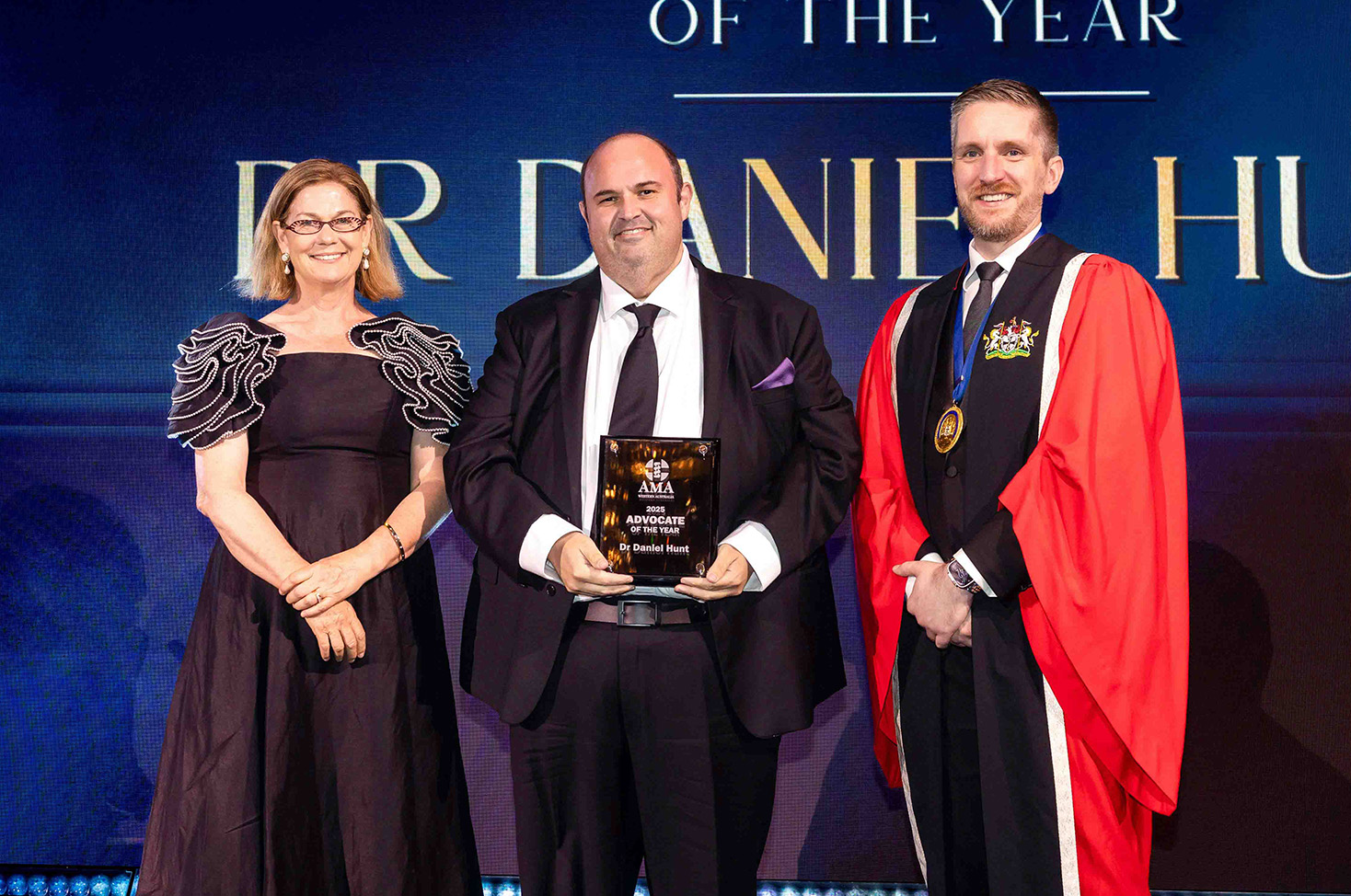
Dr Daniel Hunt at the AMA (WA) Awards, with Health & Mental Health Minister Meredith Hammat and AMA (WA) President Dr Kyle Hoath.

“We ensured those medications and our own COVID care boxes – which included cleaning agents, wipes, paracetamol, ibuprofen and general medications – could be delivered to individuals’ houses, as this was when we had to isolate for about two weeks. We also made sure food boxes with staples like baked beans, corned beef and rice were delivered to them at the same time.

“It was difficult for our patients to get access to COVID swabs initially, because they were all done through the hospitals. And, again, not the most culturally appropriate service at the time. So Derbarl Yerrigan set up two COVID swabbing sites at Maddington and Mirrabooka clinics to ensure patients had ready access to testing services.”

What lessons did Dr Hunt and his colleagues take away from that COVID experience?

“Well, I think the lessons are always the same,” he says, “because despite the sort of stereotypes that people have of Aboriginal patients, nobody wants to be alone; and everyone wants their friends and family to be healthy.

“I work in government now; but from my perspective in a not-for-profit, I think our colleagues in government need to spend a little bit more time listening to those people who are the subject matter experts, such as the Aboriginal medical services.”

While working at Derbarl Yerrigan, Dr Hunt became interested in sexual health, and he is now the chair of the WA Blood-borne Virus and Sexually Transmissible Infections Advisory (BVSTIA) Committee.

“When I was at Derbarl, the syphilis epidemic, which had not been declared, was starting to kick off. We recognised the need to start looking after those patients,” he recalls.

“Derbarl had experienced at least one congenital syphilis death of a patient’s baby. So, we partnered with the WA Department of Health to put together a syphilis point-of-care testing program, for which I was the lead in Derbarl.

“It was very successful. We were the largest testing site in Australia, and we tested more patients than any other site. We were able to treat about 20 infectious patients and ensure all patients, with either infectious or non-infectious syphilis, were treated. In that four-year period, there were no congenital syphilis cases, so I’m very proud of that.”

Dr Hunt spent his last six months at Derbarl Yerrigan as the acting Chief Executive Officer. He left the organisation last May and began working at RPH as the homeless medicine consultant in November.

“I’m the clinical lead for our homelessness program,” he says.

“ Having that level of influence, being able to provide that kind of expert advice on what we say are our healthcare needs; those are the things I’m quite proud of – being able to be a bit of a voice for Aboriginal patients, for our vulnerable patients, and for general practice.

“I basically work with in-reach teams. RPH has partnered with Ruah and Homeless Healthcare to provide an in-reach service, seven day a week, to help homeless patients navigate the healthcare system and improve their medical care.”

Dr Hunt says he is proud to play a role in influencing health policy.

“You’re being asked to provide advice on syphilis and genital syphilis, and being invited to point-of-care workshops and roundtables,” he says.

“Last year syphilis was recognised as a communicable disease of special interest by the federal government, so that really highlights the importance of working with the BVSTIA Committee, and sitting down with the Chief Health Officer to provide our advice on what we see as the needs for the State in improving how we look after, for example, a hepatitis C patient or HIV patients.

“In 2024, I was invited to a Senate inquiry on the state of dental health in Australia.

“So, having that level of influence, being able to provide that kind of expert advice on what we say are our healthcare needs; those are the things I’m quite proud of – being able to be a bit of a voice for Aboriginal patients, for our vulnerable patients, and for general practice.”

Despite being a trailblazer himself, Dr Hunt credits those who have gone before, especially his mother, Kerry, whenever he wins an award.

“Mum grew up in a time when there were still Aboriginal wings in hospitals,” he says. “A couple of years before I was born she was admitted to hospital and placed in the Aboriginal wing. That stuff is not that long ago when a sort of segregation was still apparent.

“She became an Aboriginal health practitioner when those roles first started rolling out. She worked at Perth Aboriginal Medical Service, which is now Derbarl Yerrigan, so she always had that interest in healthcare.

“Being a kind of old-fashioned parent, anything that was to do with education was always actively encouraged, but I was never pushed into medicine. It was just something that sort of happened along the way because she had that interest in it. And I just rolled with that interest, to be honest. Now I can’t conceptualise having any other job.”

“I basically work with in-reach teams. RPH has partnered with Ruah and Homeless Healthcare to provide an in-reach service, seven day a week, to help homeless patients navigate the healthcare system and improve their medical care.”

Dr Hunt says he is proud to play a role in influencing health policy.

“You’re being asked to provide advice on syphilis and genital syphilis, and being invited to point-of-care workshops and roundtables,” he says.

“Last year syphilis was recognised as a communicable disease of special interest by the federal government, so that really highlights the importance of working with the BVSTIA Committee, and sitting down with the Chief Health Officer to provide our advice on what we see as the needs for the State in improving how we look after, for example, a hepatitis C patient or HIV patients.

“In 2024, I was invited to a Senate inquiry on the state of dental health in Australia.

“So, having that level of influence, being able to provide that kind of expert advice on what we say are our healthcare needs; those are the things I’m quite proud of – being able to be a bit of a voice for Aboriginal patients, for our vulnerable patients, and for general practice.”

Despite being a trailblazer himself, Dr Hunt credits those who have gone before, especially his mother, Kerry, whenever he wins an award.

“Mum grew up in a time when there were still Aboriginal wings in hospitals,” he says. “A couple of years before I was born she was admitted to hospital and placed in the Aboriginal wing. That stuff is not that long ago when a sort of segregation was still apparent.

“She became an Aboriginal health practitioner when those roles first started rolling out. She worked at Perth Aboriginal Medical Service, which is now Derbarl Yerrigan, so she always had that interest in healthcare.

“Being a kind of old-fashioned parent, anything that was to do with education was always actively encouraged, but I was never pushed into medicine. It was just something that sort of happened along the way because she had that interest in it. And I just rolled with that interest, to be honest. Now I can’t conceptualise having any other job.”

Save the article
Previous Post
Aboriginal voices helping shape rural health programs
Next Post
Drawing another line in the sand on contaminated drinking water
Medicus
© 2026 Medicus - All Rights Reserved.

Start typing and press Enter to search

UNLOCK FULL ACCESS TO MEDICUS

You're just getting to the good part! Log in to your AMA (WA) member account to continue reading, or join today for full access to exclusive content, member benefits, and more.

Month End Offer is live!

Get up to 40% off on AMAMedius

AMA (WA) MEMBER ONLY ACCESS

Sign in using your membership email and date of birth.

If you are experiencing issues, please contact the AMA (WA) membership team via email membership@amawa.com.au