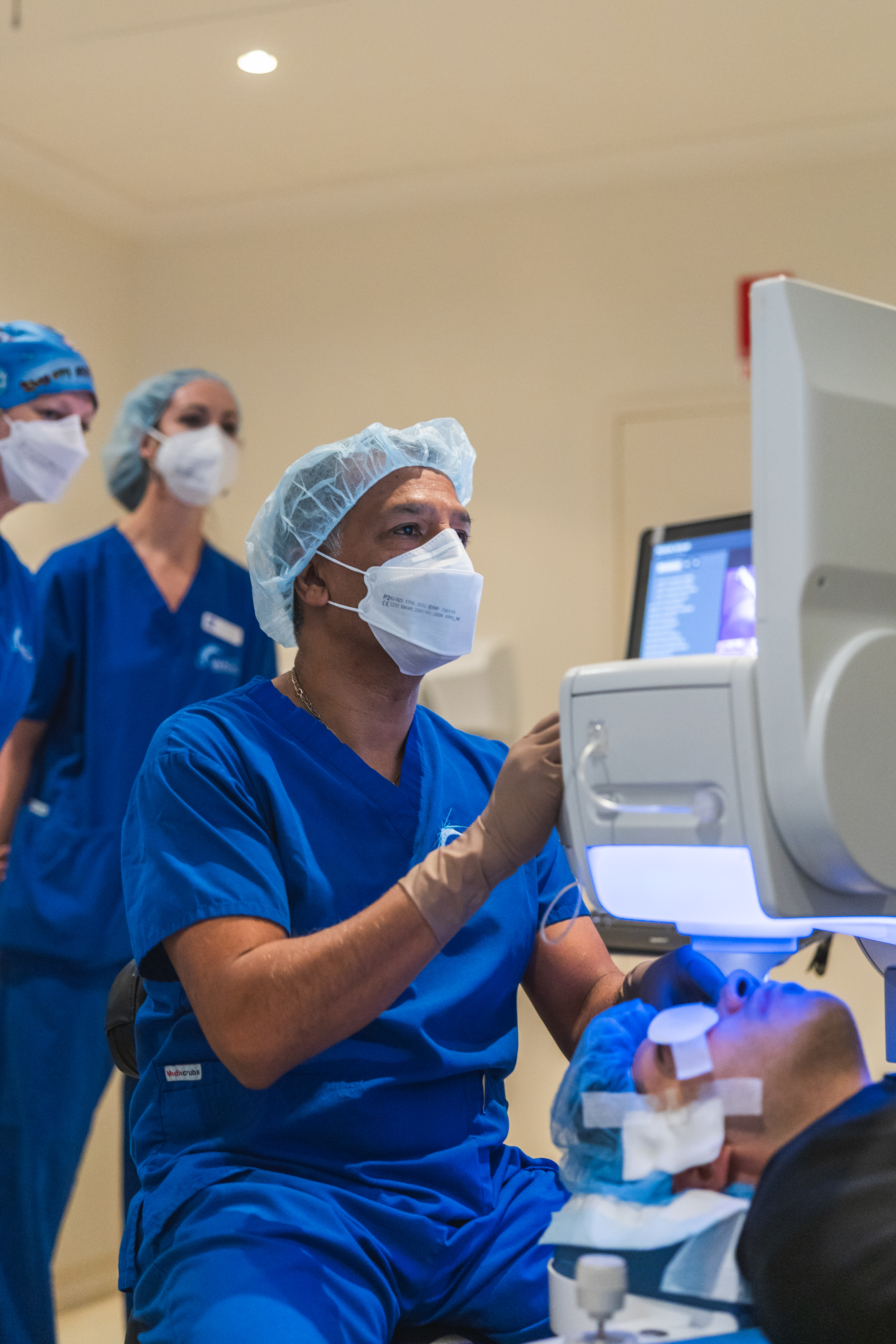
Dr Rob Paul performs laser eye surgery.
There’s something else certain in life beyond the well-known saying of “death and taxes”, according to Perth ophthalmologist Rob Paul – and that’s presbyopia, which forces people to wear reading glasses, or multifocals, when they hit their forties.
“It’s a natural part of ageing that affects the eye’s ability to focus up close because the lens of the eye no longer zooms in and out like it used to when you were younger,” Dr Paul explains.
“Traditionally, for somebody who came to me with short-sightedness or long-sightedness and wanted the best of both worlds – not just distance but also reading – we’d have to set one eye for distance and one eye for near.
“The problem with that is people would lose their three-dimensional vision and sometimes they can’t adapt to it. It put them out of whack a little bit and gave them an imbalanced type of visual feel. Only 70% of people really liked that setup.”
The latest advances in laser eye treatments mean this problem can now be overcome by using two state-of-the-art pieces of software called PRESBYOND and PresbyMAX.
“It’s been a real godsend,” says Dr Paul, “because it really allows for a much more accepting type of treatment post-operatively, where you’ve got over 90% patient satisfaction as opposed to 70% with the old traditional ways.
“It essentially creates more blended vision. It sets one eye for more distance and computer work, which is the dominant eye; and it sets the other eye for more reading and computer work. So, the intermediate vision is actually very good, and what we find is the eye that was set for reading still sees very well into the distance, so patients have fewer complaints in terms of imbalances or three-dimensional assessment problems.
“The two treatments change the spherical aberrations that occur naturally in the cornea. And what that basically does is, instead of giving you a set point, it allows an increased depth of focus; so it produces multiple points of vision. PresbyMAX creates a multifocal cornea and PRESBYOND creates a blended or increased depth of focus zone by changing the aberrations on the cornea.
“In patients who are very long-sighted, we tend to go with PresbyMAX. But for the vast majority, 90% of people, PRESBYOND treatment is more suitable and the far more popular procedure.”
Technology has come a very long way from two decades ago when the standard form of laser eye surgery, LASIK (laser-assisted in situ keratomileusis), used a blade to cut a flap in the cornea to correct refractive errors such as short-sightedness or long-sightedness.
“ The latest advances in laser eye treatments use two state-of-the-art pieces of software called PRESBYOND and PresbyMAX which essentially create more blended vision. It sets one eye for more distance and computer work, which is the dominant eye; and sets the other eye for more reading and computer work. So, the intermediate vision is actually very good.
“That was quite uncomfortable and, as you can imagine, a little bit barbaric when we think about the bladeless surgery we do now,” Dr Paul says.
“The other advance is that the blade used to take several minutes to get set up and to cut the flap. It’s now done with a laser that takes only eight seconds to create that flap.
“This minimises the risk of complications because if the laser doesn’t work the first time, it can be done automatically immediately afterwards. Whereas if you had a problem with the blade type of treatment, you’d have to cancel the surgery or delay it. So safety, accuracy and efficiency have been the real points of improvement in terms of laser eye surgery.”
Over the past few years, another advance has been a switch from creating flaps to perform laser eye surgery to something called SMILE (small incision lenticule extraction).
“This has been a major change in the way we do things because it’s essentially the closest thing to what’s called ‘keyhole’ laser,” Dr Paul says.
“Basically the laser performs a circular cut in the cornea, and we then remove that tissue through a 3mm incision, so there’s no flap. The benefit of that is you don’t have to worry about the flap dislodging, which can happen after laser eye surgery with LASIK if you have some significant trauma to the eye.
“One of the major side-effects of laser eye surgery is dryness, from one to three months – but with SMILE, because we’re not cutting a large flap on the cornea, there’s much less dry eye. The other really important benefit of SMILE is that biomechanically the eye is a lot stronger because you’re not cutting into the deeper layers of the cornea and weakening the eye as much as you would with the laser flap.”
Dr Paul says the recovery rates from laser eye surgery are two days for LASIK and one day for SMILE; and 98% of patients leave with 20/20 vision.
“On day one, we see probably around that mark, but by about three months it’s close to 99%. It keeps improving on a sort of a logarithmic scale,” he says.
With short-sighted laser treatments, whether with LASIK or SMILE, people can expect about 15 to 20 years of good vision.
“The problem is in those patients with presbyopia, where it tends to wear off after about eight years, but then it can be done again,” Dr Paul says.
“People think it can only be done once, but that’s not true. For example, if somebody who’s been treated with PRESBYOND or PresbyMAX comes back eight years later and says, ‘My reading’s worn off’, then the treatment can be done again.
“There’s only a 10% chance of it wearing off for distance, and that’s usually for people with very high degrees of short-sightedness.”
Dr Paul says the other major advance in the past 10 years has been the use of lasers in cataract surgery.
“We now use a laser to create computer-generated cuts to the eye and break up the cataract that was traditionally done manually, and this makes for more accurate results,” he says.
The procedure is called FLACS (femtosecond laser-assisted cataract surgery) and it now takes about 20-30 seconds to complete half the operation, which previously would have taken several minutes.
“The critical steps are done with the laser,” Dr Paul says, “and if you get the critical steps right in cataract surgery, everything else flows from there.”
You're just getting to the good part! Log in to your AMA (WA) member account to continue reading, or join today for full access to exclusive content, member benefits, and more.
Month End Offer is live!
Get up to 40% off on AMAMedius
Sign in using your membership email and date of birth.