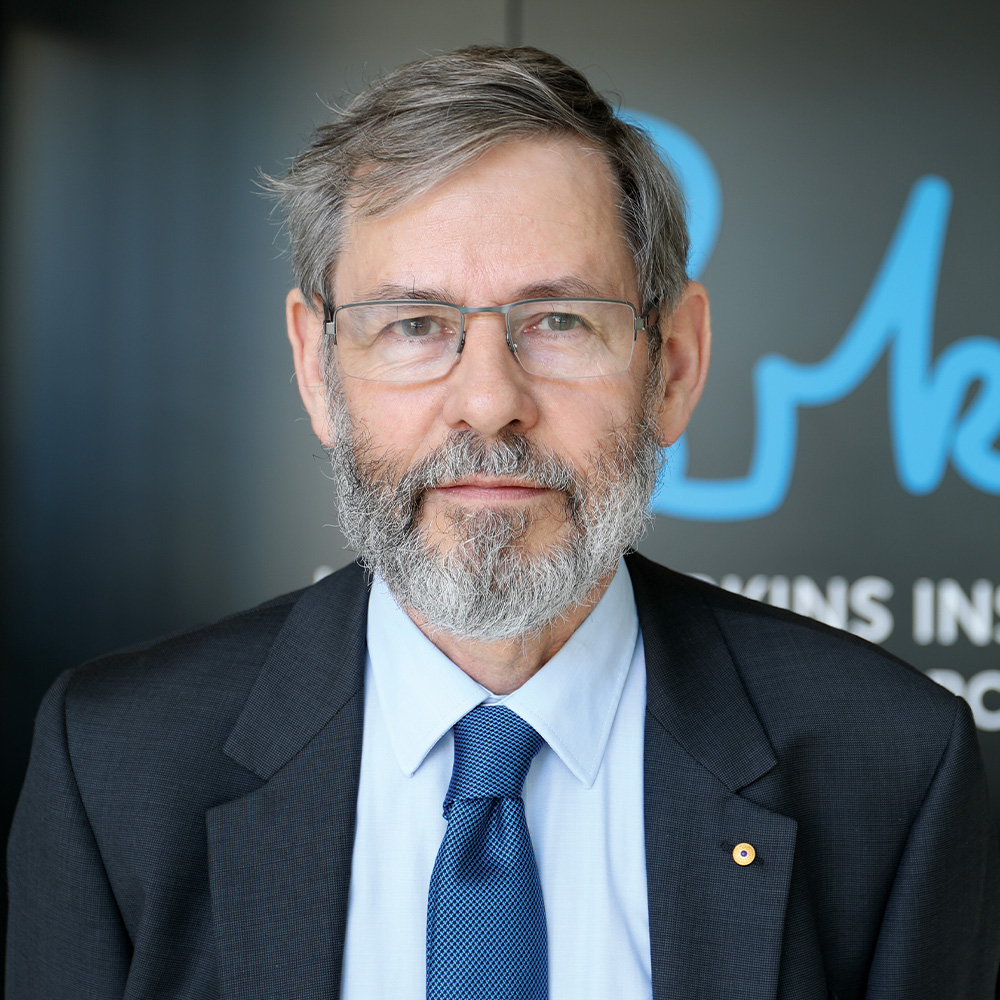
Emeritus Professor Nigel Laing AO

Genome Biology & Genetics Program
Harry Perkins Institute of Medical Research

Claim EA: Professional Reading CPD hours with AMA CPD Home. Learn more in our helpful article and log your hours.

During a successful health or medical research project, especially a clinical trial, the standard of care can increase out of sight compared to the standard of care before the project started.

But, when the research funding runs out, what happens is that the standard of care crashes back down to what it was before the project started – because there is almost always no funding to keep going what was instituted during the trial.

It is like playing snakes and ladders.

During the research project, you climb ladders to the point where you might be above the top of the board. You might achieve something that no one other than you, the researchers, thought was possible. But then the research funding runs out and you, and the standard of care, slide back down a very long snake to square zero.

This implementation ‘valley of death’ for health and medical research can last for years until what was done in the research phase is funded as standard of care. One example is the National Bowel Cancer Screening Program; it took 16 years from the end of the pilot study for it to be fully implemented. Of course, sometimes the research might never be funded into practice.

I’ve talked to many colleagues in WA and around the country, and they all have a story of successful research not being implemented. This includes colleagues working with Indigenous communities whose research has been shown to improve the health of the community members, but then the funding runs out and care reverts to what it was.

This is as frustrating for the communities as it is for the researchers.

The implementation ‘valley of death’ for health and medical research can last for years until what was done in the research phase is funded as standard of care. One example is the National Bowel Cancer Screening Program; it took 16 years from the end of the pilot study for it to be fully implemented.

I used to think about this in terms of an individual project, but I’ve come to visualise the situation as probably hundreds of millions of dollars’ worth of research stuck in a giant implementation logjam.

I’ve also wondered, looking at that vision, how much the health of Australians would improve if the logjam was unjammed, especially in the preventative health space.

In recent years, more and more researchers have been speaking up about this implementation ‘valley of death’. Perhaps our voice has finally been heard and the problem acknowledged.

The Productivity Commission’s December 2025 report, Delivering quality care more efficiently,1 called out the issue: “Resources allocated to try new approaches tend to be for relatively small-scale trials or pilots with limited timeframes. Secure and stable long-term support for proven effective programs is inadequate” (my emphasis).

Similarly, the National Health and Medical Research Strategy 2026-2036,2 released in May, devotes a whole focus area to the issue: Focus Area 3 is “Deliver high-value care through the timely translation and implementation of research findings into healthcare policy and practice” (my emphasis).

Both reports propose solutions to the problem, though the proposals vary widely.

In reality, implementing each solution will require a bespoke response delivered by people in the health systems with expertise in the relevant area. The solutions will vary from local to national.

One suggestion in the National Health and Medical Research Strategy is “a national repository of research findings ready to be translated into clinical practice” – something like a Heart Foundation Tick, I guess.

Will any of the proposed solutions work? Australia’s healthcare professionals, who want to see healthier Australians, and the Australian public must hope so.

As one of the GPs who recruited patients into the Mackenzie’s Mission reproductive genetic carrier screening project3 put it to us when the research funding ended: “No one in my district can afford expanded carrier screening. You gave me this beautiful gift which I could pass on to them. And then you took it away.”

References available on request.

Start typing and press Enter to search