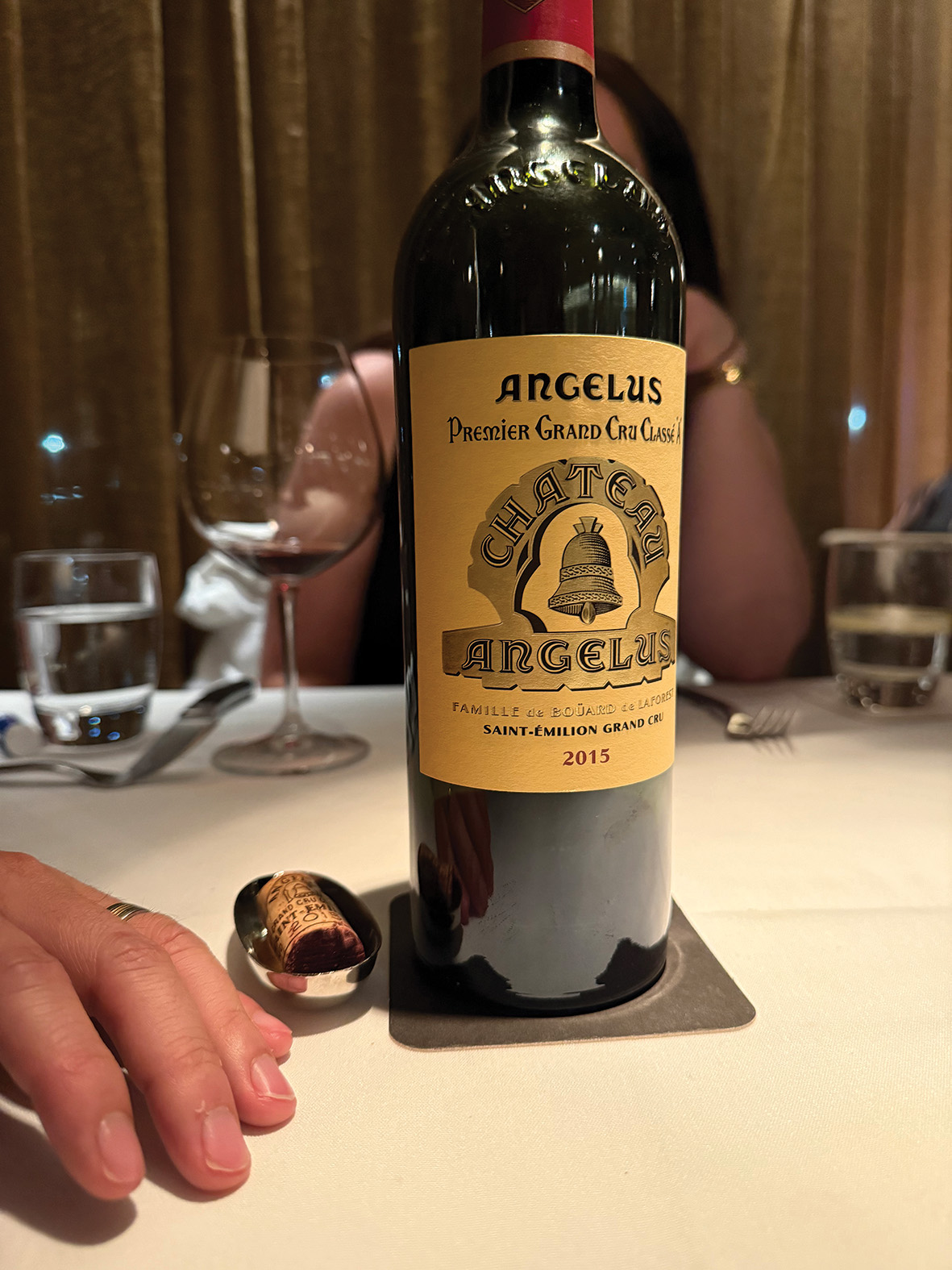
A bottle of Chateau Angelus which I oddly had two weeks before the tasting and paired very well with a fatty steak.
You may have heard that the eminent publication which houses this column has recently gone ‘open access’ and is now freely readable by all. This is slightly concerning to me, as I’m pretty sure my recent discussions are not exactly the stuff of broad appeal. Unfortunately, a return to more vulgar (in the Latin sense) fare will have to wait for next month, because I had already written about something about as far away from reality as it’s possible to get: Bordeaux’s right bank.
Bordeaux is a beautiful town in the Southwest of France, and the region is defined by water. The Gironde estuary pouches out from the Bay of Biscay, fed by the Garonne and Dordogne rivers which subdivide the region’s viticulture. The right bank is, sensibly enough, on the right side of the Dordogne, with ‘right’ being cartographically defined while facing the direction of the river’s flow.
While Bordeaux grows many different varieties, the right bank goes all-in on merlot with pockets of cabernet franc. Due to the predominance of juicy merlot, the style tends towards softer, rounder wines than the cabernet sauvignon heavy left-bankers.
Classic right-bank notes include plum, blackberry, dark cherry and coffee. The soils are predominantly clay, with some parts of limestone and gravel, and to some extent the soil dictates the vines. Merlot loves clay, while cab franc is happy enough with the more freely draining sand or limestone.
The two most famous appellations are Saint-Emilion and Pomerol, and within these it’s all about grand estates.
Unlike Burgundy, which is a patchwork of sub-divided vineyards, in Bordeaux practically every estate will have some kind of castle and a rich owner whose great-grandparents’ source of wealth is probably best not inspected too closely. In classic French style, the “best” of these estates were defined by committee in 1955 as Premiere Grand Cru Classe A, with Chateaus Ausone and Cheval Blanc coming out on top.
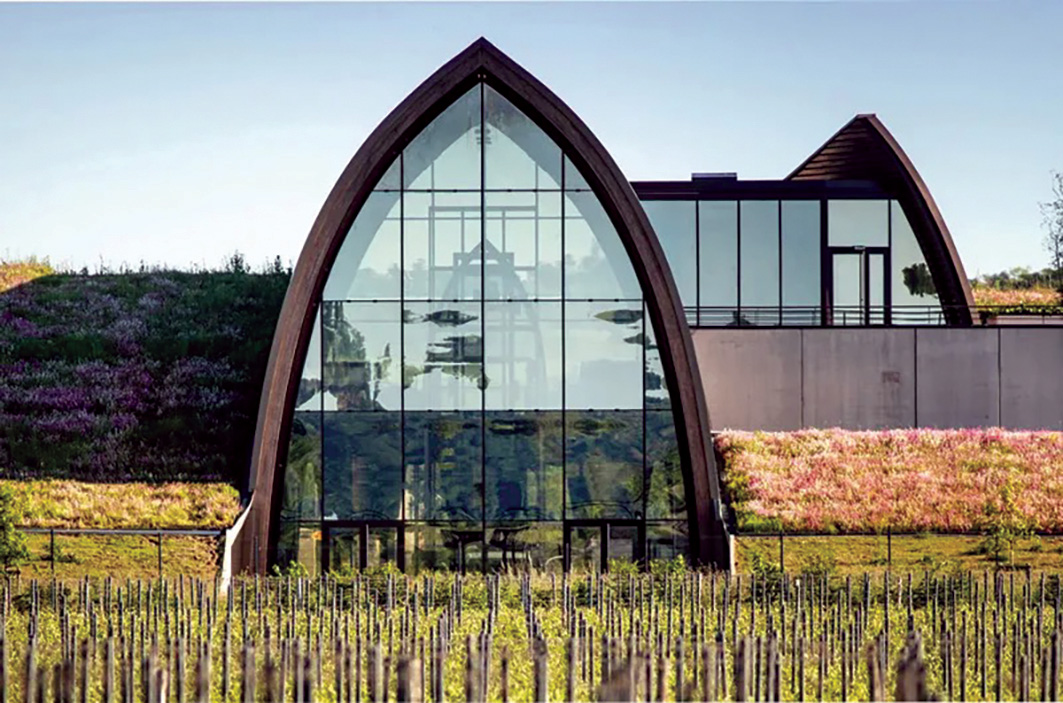
The modern winemaking facilities at Chateau Angelus echo the local church bells that form their logo.
Two newcomers joined this rank in 2012, and in a stunning coincidence the then-winemaker/owner of one of them (Chateau Angelus) was sitting on the committee. Interestingly, all but the other 2012 entrant (Chateau Pavie) and even-more-recently upgraded Chateau Figeac have recently “freed” themselves from this classification system, claiming that it relied too heavily on things like social media and not enough on grapes.
Classified or not, I recently had the opportunity to taste my way through a selection of Chateau Angelus’ range extending back to 2005. They are gorgeous wines, but for prices ranging from $1,400 to $2,500 a bottle, they had better be. With up to 50% cabernet franc to provide floral lift to the nose, they are texturally exquisite with luscious silky tannins that explode with dark plums, vanilla, tobacco leaf, leather, herbs, and all have incredible length. Should you get the chance, for me the 2005 (for now) and the 2019 (for later) were drinking best on the night, but it’s tough to go wrong.
And if you non-AMA Members accurately think me insane for having done such a thing, I promise I’ll try and be a bit more down-to-earth next time… although the weather is currently alarmingly perfect for a left-bank cabernet.